
الإمام أحمد رضا خان رحمه الله
Alahazrat Imam Ahmad Raza Khan al-Hanafi al-Qadiri
Bareilly, North India · 1272–1340 AH / 1856–1921 CE
“The Reviver of Islām, grandmaster of tafsīr, ĥadīth and fiqh, peerless Ĥanafī jurist of his time, vanquisher of innovators and enemies of religion, foremost defender of faith and the imām of Sunnis, polymath, poet, teacher, mufti, gnostic, guide.”
His life
Birth, education and first fatwas
Alahazrat Imām Aĥmad Riđā Khān al-Baraylawī was born in 1272 AH (1856 CE) in a family of scholars of Bareilly, a city in North India. His father Mawlānā Naqī Áli Khān and grandfather Riđā Álī Khān were prominent scholars of Ahl as-Sunnah in their time. Imām Aĥmad Riđā began his Islamic studies in the tutelage of his erudite father and became a Mufti at a very young age. He was a master of many sciences, and especially in Ĥanafī fiqh, he was peerless among his contemporaries. Even his adversaries have acknowledged his expertise in this discipline.
He has many ijāzahs or degrees of authorisation in Ĥanafī fiqh, and the most important among them is from the Muftī of Makkah, Shaykh Ábd ar-Raĥmān as-Sirāj ibn Ábdullāh as-Sirāj. This chain of transmission reaches Imām Abū Ĥanifah through 27 links and in further four to the Master of creation, Muĥammad RasūlAllāh ﷺ. He has an authorisation of ĥadīth transmission from the great Meccan scholar, Malik al-Úlamā, Sayyid Aĥmed Zaynī Daĥlān al-Shāfiýī. Imām Aĥmed Riđā is widely known for his refutation of Wahābīs, innovators and libertarian religion-reformers of the early 20th century CE.
Alahazrat, meaning the ‘Grand Master,’ was a common title of respect in the 13th/14th century AH. Imām Aĥmad Riđā was called as Alahazrat by his followers as he was the major force against innovators and the leader of Sunni scholars of his time. This title became so famous, that it has become a synonym for Imām Aĥmad Riđā Khān. Upon his second and eventful visit to Arabia in 1324 AH, the scholars of the two sanctuaries – Makkah and Madinah – were so impressed by his erudition and his efforts to safeguard Ahl as-Sunnah, that prominent ones among them hailed him as the Reviver of the Religion. Major scholars in (pre-partition) India agreed that all the qualities required in a Reviver were found in him and thus he is the Mujaddid of the 14th century after the Prophet’s ﷺ migration.
إِنَّ اللَّهَ يَبْعَثُ لِهَذِهِ الأُمَّةِ عَلَى رَأْسِ كُلِّ مِائَةِ سَنَةٍ مَنْ يُجَدِّدُ لَهَا دِينَهَا
The Prophet ﷺ said: “Allah will send to this ummah at the head of every hundred years someone who will renew its religion for it.”
Imām Aĥmad Riđā referred to himself as ‘the slave of the Prophet’ ﷺ or Ábd al-Muşţafā in Arabic. His skill as a jurist outshone all his other abilities; in fact, the main corpus of his work is the collection of his fatāwā. Many lengthy books that he has written are usually as a response to questions, and hence are fatāwā. Many of his rulings (and more than 150 fatāwā as monographs) were collected, indexed and ordered by the Imām himself, which he named Al-Áţāyā an-Nabawiyyah fi’l Fatāwā ar-Riđāwiyyah, popularly known in the subcontinent as Fatāwā e Razawiyyah and has been recently published in Pakistan in 30 volumes.
He took the Qādirī path and was initiated in that Sūfī order by Sayyid Aāl e Rasūl al-Aĥmadī of Mārahra in 1294. Alahazrat was an ardent lover of the Prophet ﷺ which is evident from his works.
He was also a great poet and has written sublime verse in Arabic, Persian and Urdu. His verse in Urdu and Persian is published in two parts named: Ĥadā’iq e Bakh’shish meaning ‘Gardens of Salvation’. Many of his eulogies and odes are recited, and in particular, the Ode of Salutation or the Salām has achieved unparalleled fame and acceptance among Muslims from the subcontinent.
The Imām passed away at the age of 68 in 1340 (1921). May Allah táālā have mercy on him and be well pleased with him.
18561272 AH
Birth: 10th Shawwal 1272 / 14th June 1856
18691286 AH
Graduation; Begins to Teach and Issue Legal Edicts
18781295 AH
First Hajj and Visit to the Two Sanctuaries / Ijazahs from Úlamā
19001318 AH
Hailed as Mujaddid/Reviver of the age by Indian Scholars
19041322 AH
Establishment of the School Manzar e Islām in Bareilly
Begins Compilation of Al-Fatāwā Ar-Riđawiyyah19061324 AH
Attestations on his Fatwā and Al-Dawlatu’l Makkiyyah
19121330 AH
Translation of The Qur’ān: Kanz al-Īmān
19211340 AH
Passes Away on 25th Şafar 1340 / 28th October 1921

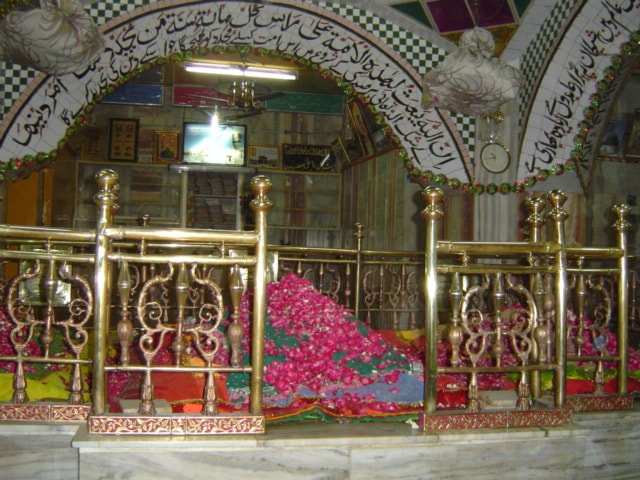
His life
Family and ancestry
Qandahār, Afghanistan
- Muĥammad Sáādat Yār KhānPathan of the Barech tribe, Qandahār; Mughal commander sent to Bareilly
- Shaykh Muĥammad Aáżam Khānwithdrew from the world and settled in Bareilly
- Ĥāfiż Kāżim Álī Khānscholar and district administrator
- Mawlānā Riđā Álī Khānprominent muftī; his grandfather and first teacher
- Mawlānā Naqī Álī Khānhis father, who taught him most of the syllabus
- Alahazrat Imām Aĥmad Riđā Khān1272–1340 AH / 1856–1921 CE
Read the family history
His father, Mawlānā Naqī Álī Khān was the son of Mawlānā Muĥammad Riđā Álī Khān, the son of Ĥāfiż Kāżim Álī Khān, the son of Shaykh Muĥammad Aáżam Khān, the son of Muĥammad Sáādat Yār Khān Bahādur, Pathan of the Barech tribe in Qandahār, Afghanistan.
The latter first came to Rohilkhand, Bareilly on an imperial mission and eventually settled there. Sáādat Yār Khān was a Shash Hazārī commander, who was appointed as the administrator of Bareilly after his victory in an important battle; yet, he never assumed office as he was on his death-bed when the royal decree arrived. His three sons, Aáżam Khān, Muáżżam Khān and Mukarram Khān also held important positions in the Mughal Empire. Shaykh Aáżam Khān withdrew from the world and became an ascetic; he retired to Bareilly and settled there.
His son Ĥāfiż Kāżim Álī Khān was a scholar and also held the post of a District Administrator in the final years of the Mughal Empire. Ĥāfiż Kāzim’s son, Mawlānā Riđā Álī Khān was a prominent mufti; and from his time onward, the family has produced distinguished muftis and scholars, Alahazrat being the most famous and arguably the most brilliant among them all. Apart from three sisters, Alahazrat had two younger brothers, Mawlānā Ĥasan Riđā Khān and Mawlānā Muĥammad Riđā Khān.
Marriage and Children
Alahazrat married in 1291. He had two sons and five daughters; both his sons, Mawlānā Ĥāmid Riđā Khān and Mawlānā Muşţafā Riđā Khān, were accomplished scholars, authors, teachers and spiritual guides. Mawlānā Ĥāmid’s son, Mawlānā Ibrāhīm Riđā was also a prominent scholar and among his children, Mawlānā Muftī Akhtar Riđā Khān [d. 1439/2018] was a senior Sunni scholar and headed the Dār-al-Iftā in Bareilly. Mawlānā Muftī Akhtar Riđā Khān was a graduate of Al-Azhar University (hence, Azharī Miyāñ) and was the author and translator of many works, including translations of Alahazrat’s books from, and into Arabic.
Love of the Prophet ﷺ
Love of the Prophet ﷺ in his life and writings
He signed himself Ábd al-Muşţafā, the slave of the Chosen One ﷺ, and no title fits him better. Everything he did or said was in the love of the Prophet ﷺ, and it is what he is known by to this day.1 He lived by the ĥadīth:
None amongst you has truly believed until I have become more beloved to you than your children, your parents and the whole of mankind.2
The purpose of his life, in his own words
In an authorisation he wrote for a scholar, he named the three things “by which, and for which” he lived:
First of all and the best of all, the most superior and the most precious: the defence of my Master, the Chief of Messengers ﷺ. Defending his ﷺ honour from the unbridled tongue of every mean and contemptible Wahābī who insolently says disrespectful things about him ﷺ. This alone is sufficient for me … Second: refuting all other heretics … Third: issuing fatāwā to the best of my ability according to the well-grounded and abundantly clear Ĥanafī madh’hab.3
When his opponents reviled him and slandered his forefathers, he answered:
I will remain content, that as long as they are busy abusing me, slandering and reviling me, they are prevented from speaking ill of my master Muĥammad ﷺ or diminishing his rank. … the coolness of my eyes is in the blessing, that my honour and the honour of my forefathers be sacrificed for the sake of Muşţafā’s honour and be a shield for his honour.4
Love as the basis of faith
His Tamhīd e Īmān (1326) is a passionate appeal to Muslims to remember that the basis of faith is love and respect of the Prophet ﷺ, and to shun those who disrespect and insult him.5 The Egyptian writer Muĥammad Khālid Thābit, who had at first believed what Alahazrat’s opponents said of him, read his books and wrote:
This I have learned – and observed – that the love of the Prophet ﷺ is an exalted station which Allāh táālā does not bestow upon a heretic, an innovator, a hypocrite or a charlatan.6
Love of the Prophet ﷺ
His poetry and the Salām
His devotional poetry fills the two volumes of Ĥadā’iq e Bakhshish: 80 poems and 8 quatrains in the first, 39 poems and 13 quatrains in the second. Its best-loved poem is the Salām; among the Sunnis of the Subcontinent and its diaspora it is as loved as the Qaşīdah Burdah is among Sunnis worldwide, and their gatherings close with it.7

مصطفیٰ جانِ رحمت پہ لاکھوں سلام / شمعِ بزمِ ہدایت پہ لاکھوں سلام
Countless salutations upon Muşţafā ﷺ, the soul of mercy;
countless salutations upon the lamp of the gathering of guidance.
He wrote in Urdu, Persian and Arabic, and some couplets move between languages:
حدائقِ بخششHadaiq-e-Bakhshish · The Gardens of Forgiveness
واہ کیا جود و کرم ہے شہ بطحا تیرا
نہیں سنتا ہی نہیں مانگنے والا تیرا
Wow, O Meccan King! How Amazing Is Your Kindness & Generosity / The One Who Seeks From You, Neither Hears ‘No’ Nor Any Negativity
لَمْ یَاتِ نَظِیرُكَ فِی نَظَرٍ مثلِ تو نہ شد پیدا جانا
جگ راج کو تاج تورے سر سوہے تجھ کو شہ دوسرا جانا
Like You, None Has Ever Been Seen or Perceived, / Like You, None Other Has Ever Been Born or Created / On Your Sacred Head The Universal Crown Has Been Placed, / As The King Of Both Worlds, You Are Most Certainly Accepted
اَلْبَحْرُ عَلَا وَالْمَوْجُ طَغٰی من بیکس و طوفاں ہوشربا
منجدھار میں ہوں بگڑی ہے ہوا موری نیّا پار لگا جانا
The Sea Level Has Risen, Strong Waves Have Lifted, / Alone And Abandoned, By The Storm, I Am Surrounded / I Am Caught In A Whirlpool, By The Violent Winds I Am Battered / Please Rescue My Ship, And Take Me To The Shore, Protected
سب سے اولیٰ و اعلیٰ ہمارا نبی ﷺ
سب سے بالا و والا ہمارا نبی ﷺ
The Greatest And Most Exalted Is Our Nabi / The Most Eminent And Most Illustrious Is Our Nabi
سرور کہوں کہ مالک و مولیٰ کہوں تجھے
باغِ خلیل کا گلِ زیبا کہوں تجھے
Shall I Refer To You As The Ruler, Or As My Master & King Shall I Refer To You? / As The Most Beautiful Flower Of The Khalil’s Garden, I Shall Refer To You
زمین و زماں تمہارے لئے مکین و مکاں تمہارے لئے
چنین و چناں تمہارے لئے بنے دو جہاں تمہارے لئے
For You, The Space And The Time Are Existing, / For You, Its Residents And Residence Are Existing / For You, All Of This And All Of That, Are Existing / Created For You, Both The Worlds, Are Existing
The couplets are copied from the printed pages of Hadaiq-e-Bakhshish;8 the English is Muhammad Afthab Cassim’s, from The Gardens of Salvation.9
He held praise of the Prophet ﷺ to be the hardest kind of poetry to write:
It is the toughest form of poetry, even though people think it is the easiest. It is like walking on the edge of a sword. This is because, if a person exaggerates, he will have elevated him ﷺ to godhood; and if he is reticent, he may diminish his lofty stature.10
The Hajj of 1323/1905
In 1323/1905 he had not planned to go on Hajj. He went with his family as far as Jhansi to see them off, when a couplet of his own came to mind:
wāa e maĥrūmi e qismat ke maiñ phir ab ke baras
rah gayā hamrah e zuwwār e madīnah ho karAlas! My fate, my misfortune! This year as well –
With visitors to Madīnah I went, only until farewell.
He went home, took leave of his mother and set out at once. On that journey he wrote al-Dawlah al-Makkiyyah, on the vast knowledge granted to the Prophet ﷺ, and the scholars of the Two Sanctuaries hailed him as the Reviver of the 14th century.11
إِنَّ ٱللَّهَ وَمَلَٰٓئِكَتَهُۥ يُصَلُّونَ عَلَى ٱلنَّبِيِّۚ يَٰٓأَيُّهَا ٱلَّذِينَ ءَامَنُواْ صَلُّواْ عَلَيۡهِ وَسَلِّمُواْ تَسۡلِيمًا ٥٦
“Indeed Allah and His angels send blessings on the Prophet; O People who Believe! Send blessings and abundant salutations upon him.”
Teachers and students
Teachers and ijāzahs
His grandfather was his first teacher. In his early years, he was taught by a teacher in Bareilly and thereafter he was instructed by Mawlānā Ghulām Qādir Beyg and Mawlānā Ábd al-Álīy Rāmpūrī for some time. Most of the traditional syllabus was taught by his own father, Mawlānā Naqī Álī Khān, who also authorised him to issue fatāwā in his fourteenth year. Shāh Abu’l Ĥusayn Nūrī [1255-1324] was his guide in taşawwuf. Alahazrat was also an autodidact, and he learned and mastered many sciences by self-instruction.
Given below is a list of prominent scholars who gave him authorisations in ĥadīth, fiqh and taşawwuf:
- Shāh Sayyid Aāl e Rasūl Marahrawī [d. 1296/1879]
- Mawlānā Muĥammad Naqī Álī Khān [d. 1297/1880]
- Shaykh Aĥmad ibn Zaynī Daĥlān al-Makkī [d. 1304/1886]
- Shaykh Ábd al-Raĥmān Sirāj al-Makkī [d. 1301/1883]
- Shaykh Ĥusayn ibn Şāliĥ Jamal al-Layl [d. 1302/1884]
- Shaykh Abu’l Ĥusayn Aĥmad al-Nūrī [d. 1324/1906]
- Mirzā Ghulām Qādir Beyg al-Baraylawī [d. 1336/1917]
- Mawlānā Ábd al-Álīy al-Rampūrī [d. 1303/1885]
Alahazrat received authorisations in thirteen different chains of ţarīqah, which he forwarded by granting authorisations to others.
Muĥammad Rasūlallāh ﷺ
Ábdullāh ibn Masúūd Álqamah and Al-Aswad Ibrāhīm [al-Nakhaýī] Ĥammād ibn Abi Sulaymān Imām Abū Ĥanīfah Muhammad ibn al-Ĥasan Abū Ĥafş al-Kabīr Abū Ábdullāh ibn Abū Ĥafş Ábdullāh al-Subadhmūnī Abū Bakr ibn Fađl al-Bukhārī Qāđī Abū Álī al-Nasafī Shams al-A’immah al-Ĥalwānī Fakhr al-Islām al-Bazdawī Burhānuddīn al-Marghīnānī Ibn Ábd al-Sattār al-Kardarī Jalāluddīn al-Kabīr Ábd al-Azīz al-Bukhārī Jalāluddīn al-Khabbāzi Álā’uddīn Sīyrāfī Sirāj Qāri al-Hidāyah Kamāl ibn Humām Ábd al-Barr ibn Shiĥnah Aĥmad ibn Yūnus al-Shilbī Úmar ibn Nujaym, Shams al-Ĥānūtī and Áli al-Maqdisi, who taught Aĥmad al-Shawbarī; and Ábdullāh an-Naĥrīrī, Muhammad al-Masīrī, Muhammad al-Ĥamawī and Aĥmad al-Muĥibbī, who taught Ĥasan Shurunbulālī Ismāýīl al-Nablūsī Ábd al-Ghanī al-Nablūsī Álī Zādah al-Bukhārī Ábd al-Qādir ibn Khalīl Yūsuf al-Mizjāji al-Zabīdī Muĥammad Áābid al-Sindī Jamāl ibn Ábdullāh Ábd ar-Raĥmān al-Sirāj, Muftī of Makkah
Aĥmad Riđā Khān
Each scholar took the fiqh from the one above him, as written in his Fatāwā Riđawiyyah.12
Teachers and students
Students and successors
Graduating from a famous school is deemed an accomplishment; being the student of a great teacher is a badge of honour; and to be the mentor of great achievers is a mark of distinction. Alahazrat left behind many disciples and students who were not only great men themselves, but were also mentors to many high achievers. The following are his prominent students and deputies [khulafā]:
- His eldest son, Mawlānā Ĥāmid Riđā Khān [d. 1362/1943]
- His second son, Mawlānā Muşţafā Riđā Khān [d. 1402/1981]
- Mawlānā Amjad Álī Aáżamī [d. 1367/1948]
- Mawlānā Sayyid Naýīmuddīn Murādābādī [d. 1367/1948]
- Mawlānā Sayyid Żafaruddīn Bihārī [d. 1382/1962]
- Mawlānā Sayyid Aĥmad Ashraf Kichauchawī [d. 1343/1925]
- Mawlānā Sayyid Dīdār Álī Alwārī [d. 1354/1935]
- Mawlānā Aĥmad Mukhtār Şiddīqī Meeruti [d. 1357/1938]
- Mawlānā Sayyid Muĥammad al-Kichauchawi [d. 1383/1961]
- Mawlānā Ábd al-Álīm Siddīqī Meeruti [d. 1374/1954]
- Mawlānā Ábd al-Salām Jabalpūrī [d. 1372/1953]
- Mawlānā Ábd al-Aĥad Pīlībhītī [d. 1348/1929]
- Mawlānā Điyāuddīn Aĥmad al-Madanī [d. 1401/1981]
- Mawlānā Laál Muĥammad Khān Madrāsī [d. 1339/1921]
- Mawlānā Muĥammad Raĥīm Bakhsh Ārwī [d. 1343/1925]
- Mawlānā Ĥasanayn Riđā Khān [d. 1402/1981]
- Mawlānā Ábd al-Bāqī Burhān al-Ĥaq Jabalpūrī [d. 1405/1985]
- Qāđī Ábd al-Waĥīd Áżīmābādī [d. 1326/1908]
- Mawlānā Muftī Taqaddus Álī Khān [d. 1408/1988]
- Shaykh Sayyid Sulaymān Ashraf Bihārī [d. 1358/1939]
The following prominent Arab scholars have received ijāzah in ĥadīth and other sciences from Alahazrat:
- Mawlānā Sayyid Ábd al-Ĥayy al-Kattānī [d. 1382/1962]
- Shaykh Şāliĥ Kamāl al-Makkī
- Shaykh Sayyid Ismāýīl ibn Sayyid Khalīl [d. 1338/1919]
- Shaykh Sayyid Muşţafā ibn Sayyid Khalīl [d. 1339/1920]
- Shaykh Aĥmad ibn Abi’l Khayr Mīrdād
- Shaykh Muĥammad ibn al-Marzūqī Abū Ĥusayn
- Shaykh Ĥasan al-Újaymī
- Shaykh As’ád al-Dahhān al-Makkī
- Shaykh Ábd al-Qādir al-Kurdī
- Shaykh Muĥammad Saýīd al-Maghribī
- Shaykh Sayyid Sālim ibn Áydarūs
- Shaykh Sayyid Abū Bakr ibn Sālim
Alahazrat has mentioned some more úlamā in Al-Ijāzāt al-Matīnah li Úlamāyi Bakkah wa’l Madīnah. He also listed the names of all his prominent disciples in a lengthy poem Al-Istimdād álā Ajyāl al-Irtidād.
Works and sciences
Written works
- 679of his works known by name
- 30volumes of his magnum opus, al-Fatāwā al-Riđawiyyah
- 206monographs within those 30 volumes
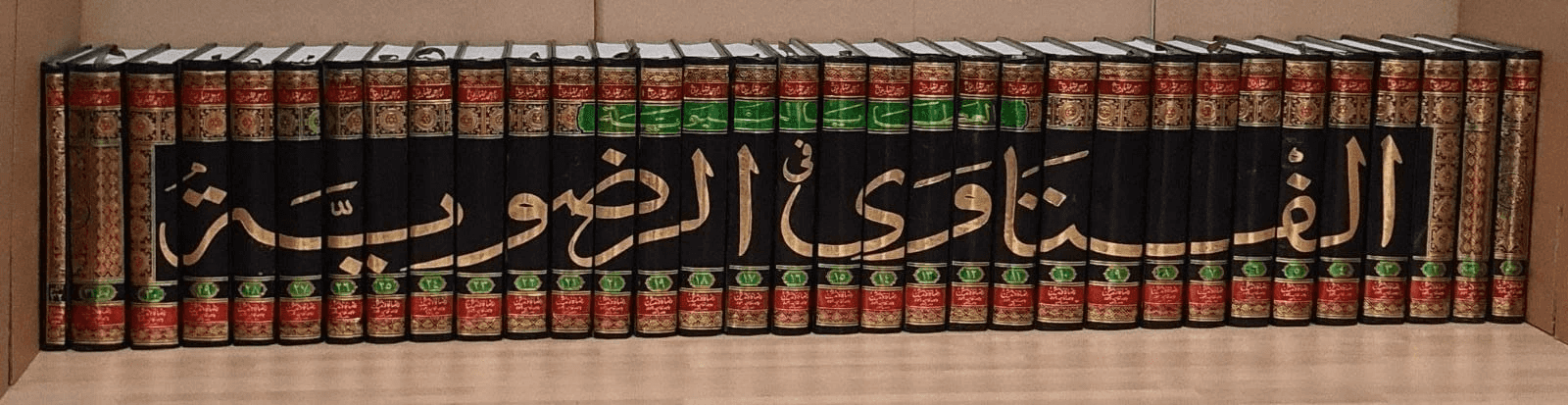
Alahazrat was a prolific author who began writing from a very early age. It is said that he authored nearly 1000 works and the names of 679 are known. These works include both original works, commentaries, annotations and one or two translations as well. Al-Ataya al-Nabawiyyah fi’l Fatawa al-Ridawiyyah, is his magnum opus published in 30 volumes (with translation of cited Arabic and Persian passages) or 22 volumes (which are fatawa in their original form sans translations). Even though many books published as separate monographs eventually found their way into the Fatawa, there are about 25-30 works that are not found therein. Given below is a short list of some of his famous works. See here for various bibliographies and here for a complete list of published works (until 2021) available for download.
- Kanz al-Īmān: An explanatory translation of the Qur’ān in Urdu.
- Al-Mustanad al-Mútamad: A commentary on the Arabic work Al-Mútaqad al-Muntaqad by Imām Fađl ar-Rasūl al-Badāyūnī.
- Jidd al-Mumtār: A five volume supercommentary on Radd al-Muĥtār of Imām Sayyid Muĥammad Amīn Ibn Áābidīn al-Shāmī, which is arguably, the most widely used Ĥanafī text in latter times.
- Al-Dawlatu’l Makkiyyah bi’l Māddati’l Ghaybiyyah: A comprehensive work on the knowledge of RasulAllah ﷺ
- Al-Amn wa’l Úlā li Nāýiti’l Muşţafā bi Dāfiý al-Balā’a
- Tamhīd e Īmān: A treatise on the fundamentals of faith as known from Quranic verses.
- Dhayl al-Muddáā li Aĥsan al-Wiáā li Ādāb al-Duáā: A gloss on his father Imam Naqi Ali’s work on the etiquette of Dua.
- Al-Fađl al-Mawhibī fī Máana: idhā şaĥĥa’l ĥadīthu fa huwa madh’habī
- Fatāwā al-Ĥaramayn bi Rajafi Nadwatu’l Mayn: Refutation of the Nadwah that sought to create syncretic Islam.
- Fatāwā Āfriqah: A small collection of rulings in response to questions from the Indian diaspora settled in South Africa.
- Sub’ĥān as-Subbūĥ án Áybi Kadhibin Maqbūĥ: A masterpiece refuting belief of Deobandis that it is possible for Allah ta’ala to speak falsehood. This dead heresy of ancient Mutazilah was revived by Ismayil Dihlawi and is defended by his followers, the Deobandis.
- Radd al-Rifđah: Refutation of the Rafidi sect.
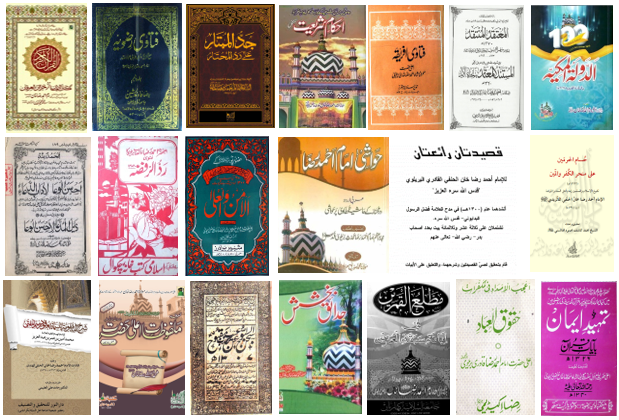
Show 28 more of his famous works
- Qahr al-Dayyān álā Murtadd bi-Qādiyān: Refutation of Mirza Ghulam Ahmad Qadiyani, the false prophet.
- Niým al-Zād li Rawm al-Đād: On Tajwid, and the pronunciation of the letter Daad in Arabic.
- Al-Zubdatu’z Zakiyyah li Taĥrīmi Sujūd at-Taĥiyyah: A detailed ruling that prostration to graves and holy men is forbidden by the Shariah.
- Kifl al-Faqīh al-Fāhim fī Aĥkāmi Qirtās al-Darāhim: On the Sharayi status of currency notes and related rulings.
- Jalī an-Naşş fī Amākin ar-Rukhaş: On the circumstances which permit one to avail of concessions in Sharayi rulings.
- Barakāt al-Imdād li Ahl al-Istimdād: Permissibility of seeking intercession from Awliya and Anbiya.
- Al-Zahr al-Bāsim fī Ĥurmati’z Zakāh álā Banī Hāshim: Ruling that it is forbidden to give zakat to the immediate family of RasulAllah ﷺ
- Masā’il e Samāá: Ruling that music is haram and the claim that sufis permitted it is false.
- Al-Zulāl al-Anqā min Baĥri Sabqati’l Atqā: On the superiority of Abu Bakr al-Siddiq
- Madārij Ţabaqāt al-Ĥadīth
- Al-Rawđ al-Bahīj fī Ādāb al-Takhrīj
- Al-Hād al-Kāf fī Ĥukm al-Điáāf: A detailed exposition on the acceptance of weak hadith in rulings.
- Al-Nahy al-Akīd án as-Şalāti Warā’a Ídā al-Taqlīd: Ruling that it is impermissible to pray behind a la-madh’habi (salafi), who rejects madh’habs.
- Hada’iq e Bakhshish: A collection of devotional poetry and praise of the Prophet ﷺ in 2 volumes.
- Al-Istimdad ala Ajyal al-Irtidad: A long narrative poem which starts with the praise of the Prophet ﷺ and seeks his intercession (istimdad) against heretics who are also refuted in this poem; and the imam also mentions his disciples and students in this poem praising them.
- Ahkam e Shariat: A short collection of fatawa in 3 volumes (separate from the large collection)
- Husam al-Haramayn: A fatwa and collection of attestations on the fatwa of Alahazrat against Deobandi elders for their blasphemies.
- Qasidatan Ra’yiatan: Two odes in Arabic in tribute of the great Indian scholar, Imam Fadl al-Rasul Badayuni and his son, Mawlana Abdu’l Qadir Badayuni. Alahazrat wrote these odes in high Arabic when he was only 28, which showcases his command of the Arabic language.
- Sharh Uqud Rasm al-Mufti: A gloss on Ibn Abidin’s famous work on Rasm al-Mufti.
- Al-Malfuz: His dicta collected in four volumes by his youngest son, Mawlana Mustafa Rida Khan.
- Inba’a al-Hayy li anna Kalamahu’l Masun Tibyanan li Kulli Shayy.
- Marginalia on Tahtawi’s commentary of Al-Durr al-Mukhtar (published).
- Annotations on Fatawa Qadi Khan (published).
- Annotations on Sahih al-Bukhari (published).
- Marginalia on Al-Hidayah of Marghinani (published).
- Commentary on Musallam al-Thubut, a prominent text on Hanafi principles of jurisprudence (unpublished).
- Matla’a al-Qamarayn fi Ibanati Sabaqati’l Umarayn: That Abu Bakr and Umar (may Allah be pleased with them both) are superior to everyone else after Prophets and Messengers.
- Al-Ijazat al-Matinah li Ulama’ Bakkah wa’l Madinah: The authorisations he granted to the scholars of the two sanctuaries on his second Hajj in 1323-24.
This is a short list of his important works. 206 monographs are included in the 30-Volume Fatawa Ridawiyyah, which can be found in the download section. Reviews of books will be added in the future, in sha’Allah.
Works and sciences
Proficiency in fifty-five sciences
Alahazrat was proficient in fifty-five branches of knowledge which he has mentioned himself in his authorisation to Shaykh Ismāýīl Khalīl which was formalised in a written document on 8th Şafar 1324. While some of these sciences are grouped under one head in our time, these were specialisations in the previous century, just as we have specialisations in our time.
For example, engineering was one broad discipline, not long ago and which, in our times has been subdivided into scores of specialist areas. Syntax, morphology, lexicology and semantics may appear unimportant to ordinary minds; but, these branches of knowledge are extensive and they have a steep learning curve. Those who aspire to progress beyond intermediate studies are required to gain an expertise in these sciences. Imām Fakhruddīn Rāzī in his Jāmiý al-Úlūm, Imām Jalāluddīn Suyūţī in Al-Nuqāyah/Itmām al-Dirāyah, Shaykh Tāsh Kubrīzādah in his Miftāĥ al-Sáādah, Nawab Şiddīq Ĥasan Qinnawjī Bhopālī in Abjad al-Úlūm have all considered and treated these as separate sciences.
Inevitably, a poor grasp of fundamental concepts and ignorance of essential sciences results in misunderstanding of texts; which is reflected in the blunders committed by many wayward scholars and pretenders who base their arguments on false premises. Some sciences in the below list may have now become obsolete, but Alahazrat had mastered them in an age when they were current and important.
- Qur’ānic Sciences
- Ĥadīth Sciences
- Principles of Ĥadīth
- Jurisprudence (Ĥanafī school)
- Jurisprudence (other schools)
- Principles of Fiqh
- Polemics
- Qur’ānic Exegesis, Commentary
- Creed, Rational Theology
- Syntax
- Morphology
- Semantics
- Pragmatics
- Rhetoric, Figures of Speech
- Logic
- Debate
- Philosophy
- Fractions
- Astronomy
- Numeracy
- Geometry
- Recitations, Readings of the Qur’ān
- Phonology and Phonetics [for Qur’ān Pronunciation]
- Taşawwuf, Sufism
- Ethics
- Morality and Etiquette
- Biographical Evaluation of Narrators
- Biographies
- Histories
- Lexicology and Etymology
- Literature and Associated Sciences
- Arithmetic
- Algebra
- Sexagesimals
- Logarithms
- Chronometry, Calculation of Timings and Prayer Schedules
- Science of Perspective and Optics
- Spherical Geometry
- Astrometry
- Spherical Trigonometry
- Plane Trigonometry
- Modern Astronomy, Planetary Science, Cosmology
- Quadratic Equations
- Jafar
- Zayircha13
- Arabic Verse [Prosody]
- Arabic Composition
- Persian Verse [Prosody]
- Persian Composition
- Urdu Verse [Prosody]
- Urdu Composition
- Calligraphy: Naskh
- Calligraphy: Nastáliq
- Recitation with Tajwīd
- Inheritance14
Alahazrat has merged subdisciplines and interdisciplinary subjects under a single major heading. For example, Qur’ānic sciences would be eighty in number; and even if we group most minor topics, we will still be left with more than a dozen major branches that require a separate study; but in this list they are counted as one. After listing this, Alahazrat writes:
I seek Allāh’s refuge. I do not say this to boast about my abilities, nor in vanity or pride – [I mention this] only to thank for the bounties of my Lord upon me. Also, I do not claim to be an expert in these sciences.
Notwithstanding his self-effacing comments, his expertise is evident from his works and acknowledged by people accomplished in their fields, unlike many of his contemporaries whose achievements are extolled by admirers, but cannot always be corroborated by independent sources.
The Arab world
Recognition by scholars of the Arab world
His name reached the Arab world in his own lifetime. On his second Hajj, in 1323–24 (1905–06), the scholars of Makkah and Madinah sought his authorisation and endorsed his work; a muḥaddith of Fez listed him among his shaykhs; and scholars of Damascus and Beirut wrote in praise of his book on the knowledge granted to the Prophet ﷺ. Today he is studied at al-Azhar.
- Bareilly His home, where their letters and endorsements reached him.
- Makkah Its muftis and the imams of the Ḥaram endorsed his fatwa and took his ijāzah, 1905–06.
- Madinah Its Ḥanafī and Shāfiʿī muftis endorsed his fatwa; visiting scholars of Damascus and Beirut wrote their praise of his book here, 1912–15.
- Fez ʿAbd al-Ĥayy al-Kattānī named him among his shaykhs in Fihris al-Fahāris.
- Damascus The Muftī of Damascus and scholars of the city, with Yūsuf al-Nabhānī of Beirut, praised al-Dawlah al-Makkiyyah.
- Cairo Al-Azhar: an MA thesis on his fiqh (1997) and a memorial volume (1999).
The Maghrib: al-Kattānī of Fez
On 26 Dhu’l-Ĥijjah 1323 (February 1906), as Alahazrat was finishing al-Dawlah al-Makkiyyah in Makkah, a visitor he had never met sent word that he wished to come and take from him: the Moroccan muḥaddith Muĥammad Ábd al-Ĥayy al-Kattānī of Fez, then on Hajj. He came the next morning, heard from him the ĥadīth that is narrated first (al-musalsal bi’l-awwaliyyah), and took his authorisation in ĥadīth and the Sufi paths.15
In his great catalogue of chains of transmission, Fihris al-Fahāris wa’l-Athbāt, al-Kattānī names him among his own shaykhs nine times. Of that first meeting he writes:16
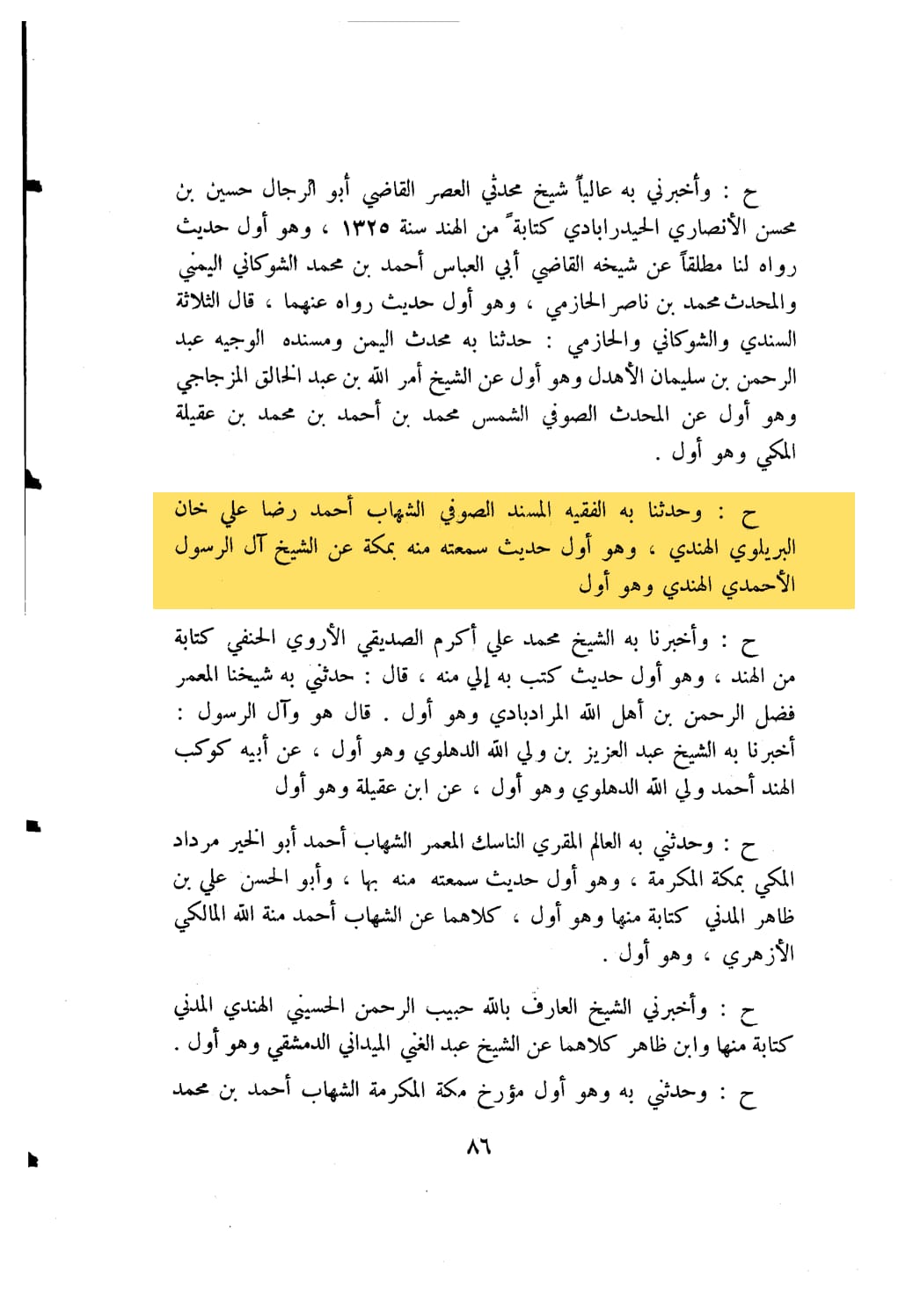
وحدثنا به الفقيه المسند الصوفي الشهاب أحمد رضا علي خان البريلوي الهندي، وهو أول حديث سمعته منه بمكة
The jurist, the musnid, the Sufi, Shihāb al-Dīn Aĥmad Riđā Álī Khān al-Baraylawī al-Hindī narrated it to us; it was the first ĥadīth I heard from him, in Makkah.
In another work he describes him:17
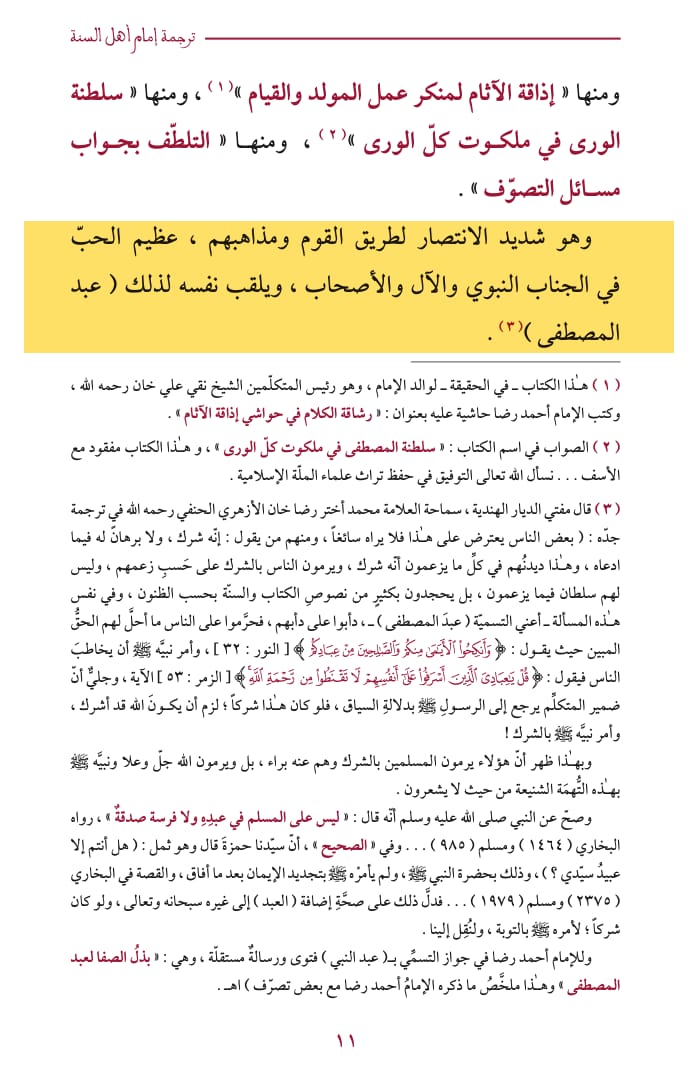
وهو عظيم الصيت كثير التصنيف … وهو شديد الانتصار لطريق القوم ومذاهبهم، عظيم الحب في الجناب النبوي والآل والأصحاب، ويلقب نفسه لذلك (عبد المصطفى)
He is of great renown and very prolific … a fierce defender of the way of the Sufis, of great love for the Prophet ﷺ, his Family and his Companions; and for that he calls himself Ábd al-Muşţafā.
The Two Sanctuaries
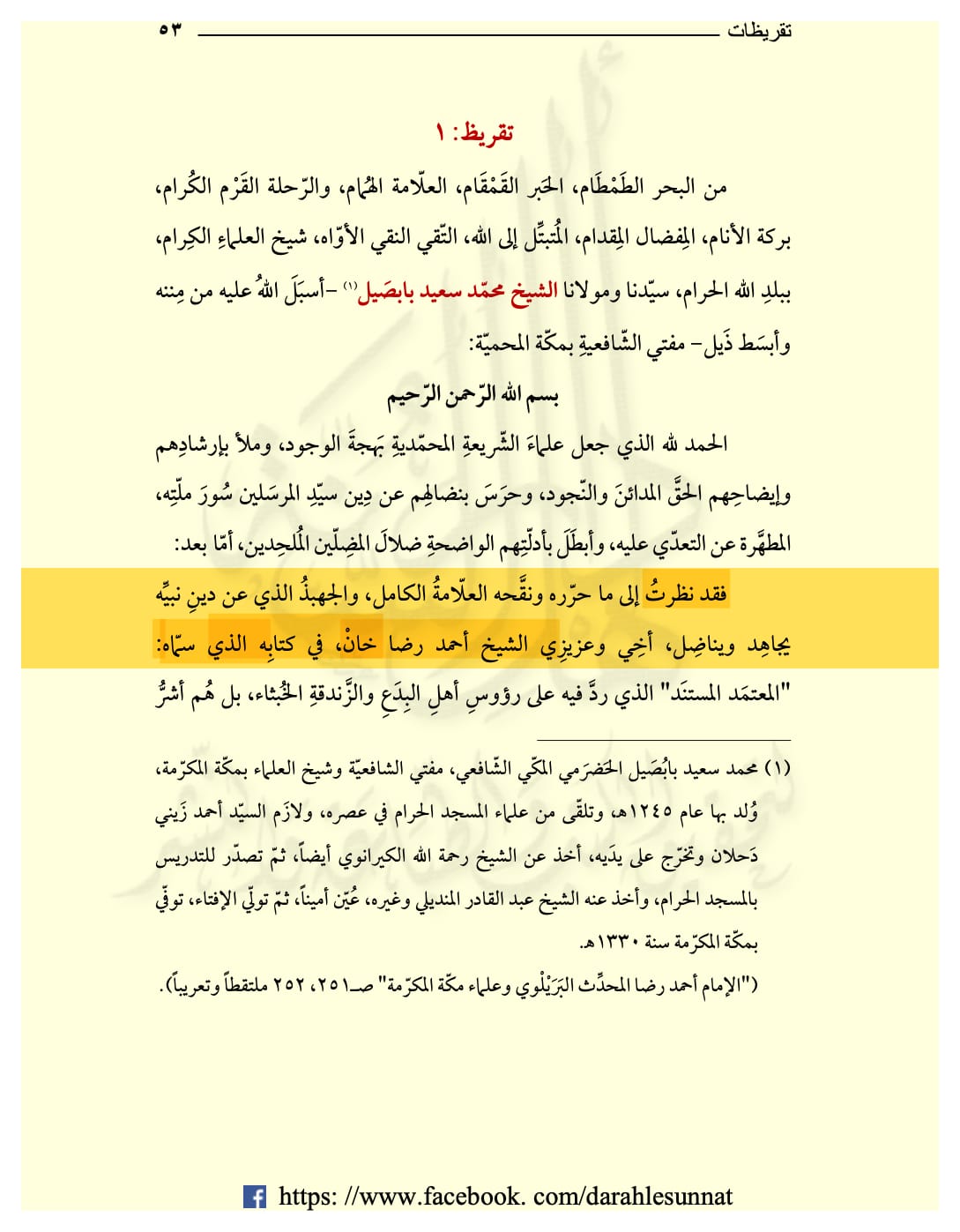
On the same journey he put his fatwa on those he held to have insulted the Prophet ﷺ before the scholars of Makkah and Madinah. Thirty-five of them endorsed it — among them the Shāfiʿī and Mālikī Muftīs of Makkah and the Ḥanafī and Shāfiʿī Muftīs of Madinah, and scholars whose families came from Hadramawt, the Maghrib, Tunisia and Algeria. Their endorsements were published in 1325 as Ĥusām al-Ĥaramayn.18 The Shāfiʿī Muftī of Makkah, Muĥammad Saýīd Bābşayl, began his:
فقد نظرت إلى ما حرره ونقحه العلامة الكامل، والجهبذ الذي عن دين نبيه يجاهد ويناضل، أخي وعزيزي الشيخ أحمد رضا خان
I have looked at what was written and refined by the accomplished állāmah, the master scholar who strives and fights for the religion of his Prophet ﷺ, my brother and dear one, Shaykh Aĥmad Riđā Khān.19
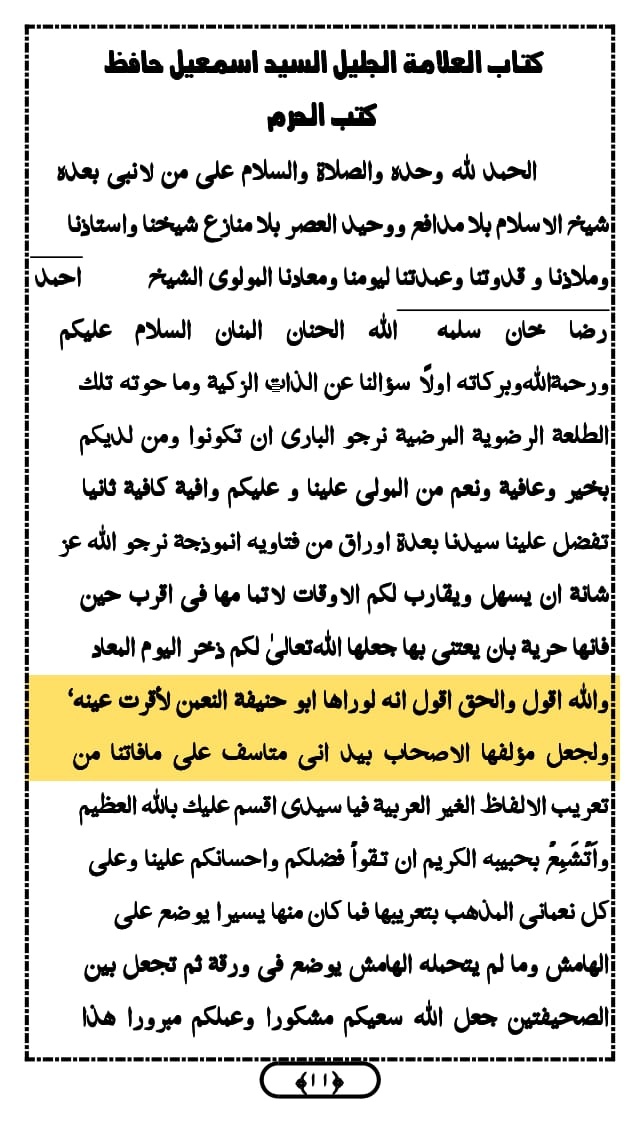
Ismāýīl ibn Khalīl, keeper of the books of the Ĥaram in Makkah, addressed him as “Shaykh al-Islām beyond dispute, the unique one of the age beyond contest”, and wrote of the fatwas he had seen:
والله أقول والحق أقول: إنه لو رآها أبو حنيفة النعمان لأقرت عينه، ولجعل مؤلفها من الأصحاب
By God I say, and the truth I say: had Abū Ĥanīfah al-Nuýmān seen them, they would have delighted him, and he would have counted their author among his companions.20
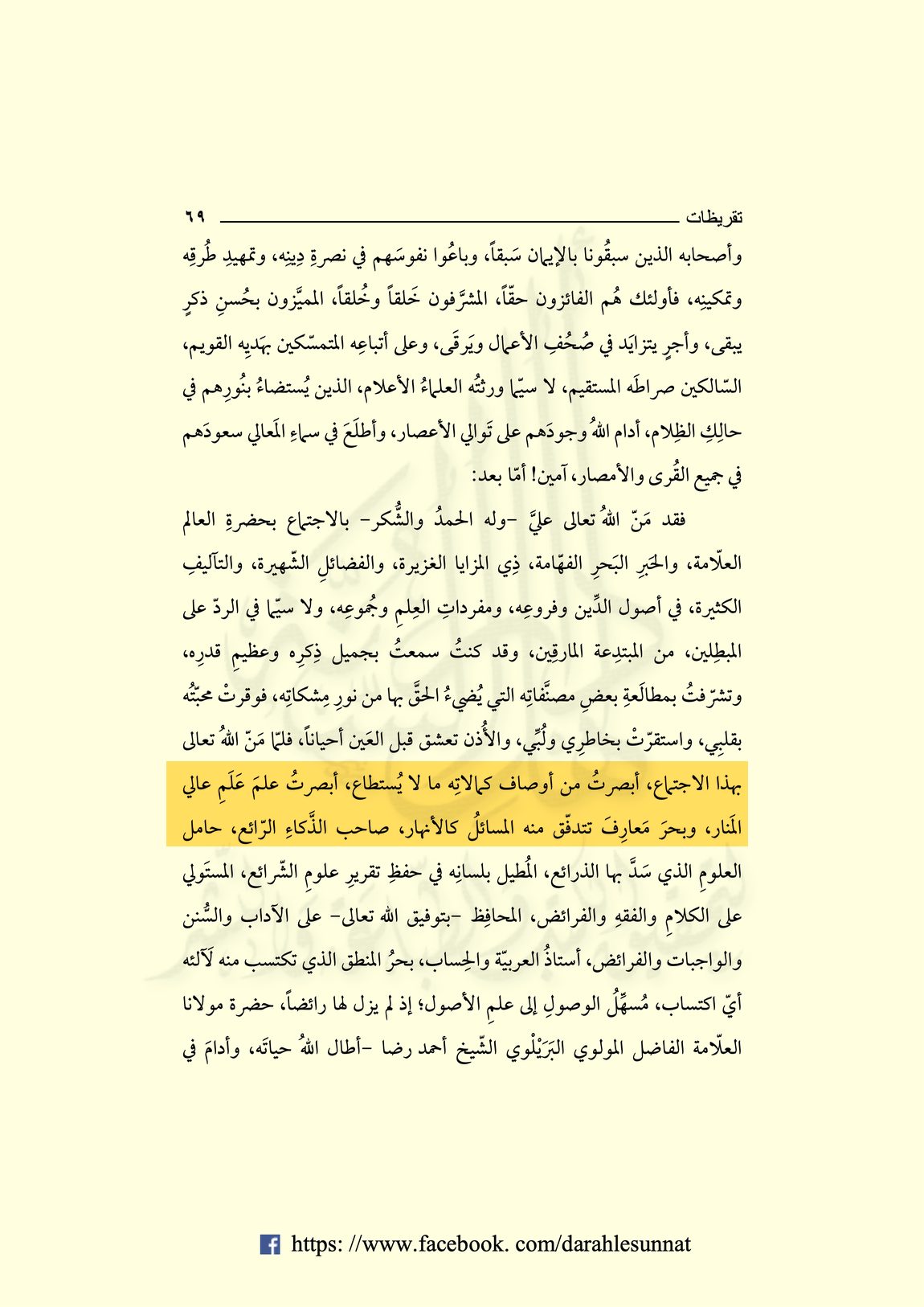
Muĥammad al-Marzūqī Abū Ĥusayn of Makkah, who also took his ijāzah, wrote of their meeting:
أبصرتُ علمَ عَلَمِ عالي المَنار، وبحرَ مَعارِفَ تتدفّق منه المسائلُ كالأنهار
I found him the standard of knowledge, a colossal lighthouse, an ocean of gnosis [márifah] from which learning flows as a gushing stream.21
Bilād al-Shām
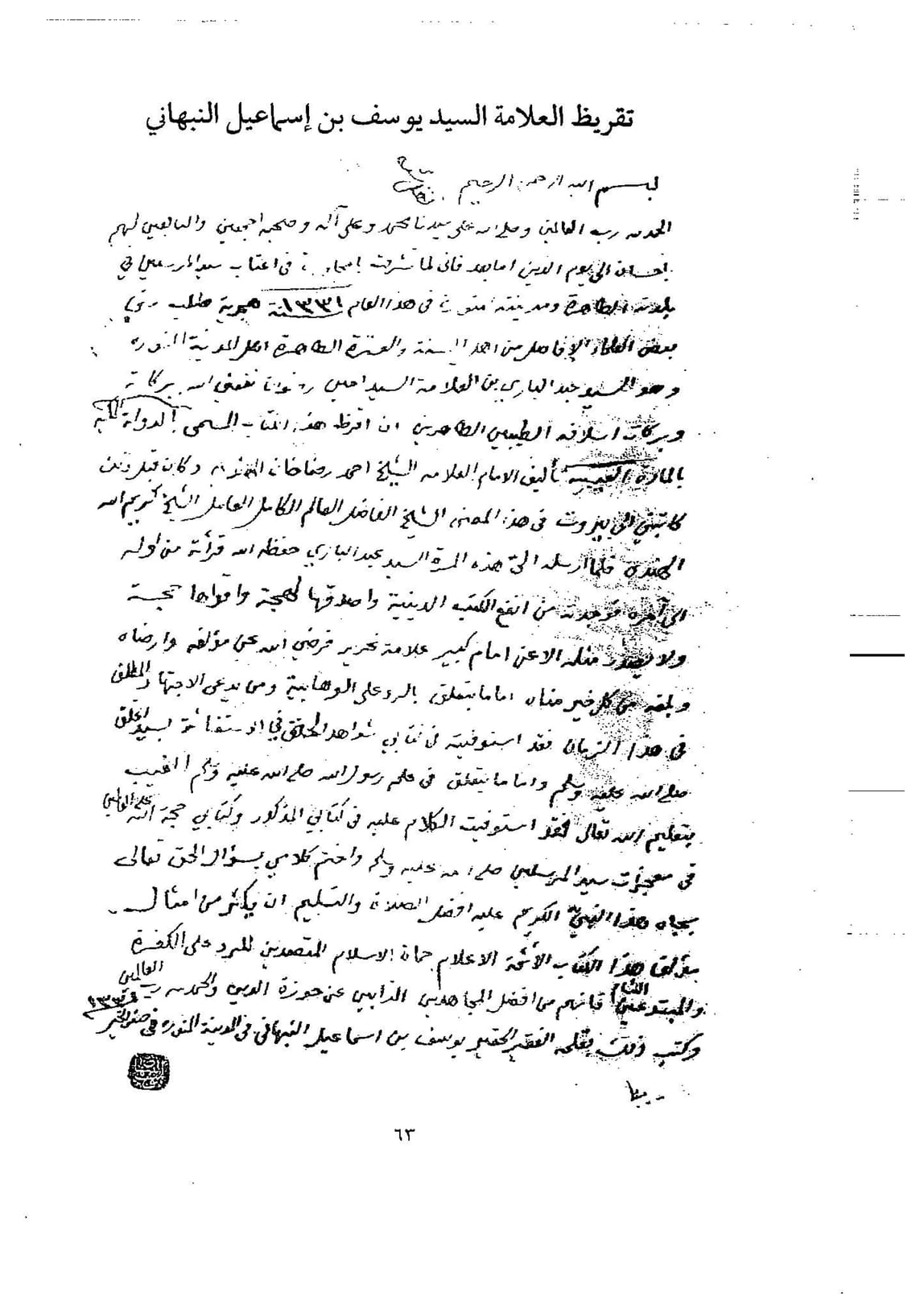
In Ṣafar 1331 (January 1913) the scholar Yūsuf al-Nabhānī of Beirut, author of Shawāhid al-Ĥaqq, was staying in Madinah when he was asked to endorse al-Dawlah al-Makkiyyah, Alahazrat’s book on the knowledge of the unseen granted to the Prophet ﷺ. He wrote in his own hand:
قرأته من أوله إلى آخره، فوجدته من أنفع الكتب الدينية وأصدقها لهجة وأقواها حجة، ولا يصدر مثله إلا عن إمام كبير علامة نحرير، فرضي الله عن مؤلفه وأرضاه
I read it from beginning to end and found it among the most beneficial of religious books, the most truthful in tone and the strongest in proof. Its like comes only from a great imam, a meticulous állāmah. May God be pleased with its author and please him.
He closed by asking God to “increase the likes of this book’s author: eminent imams, defenders of Islam”.22
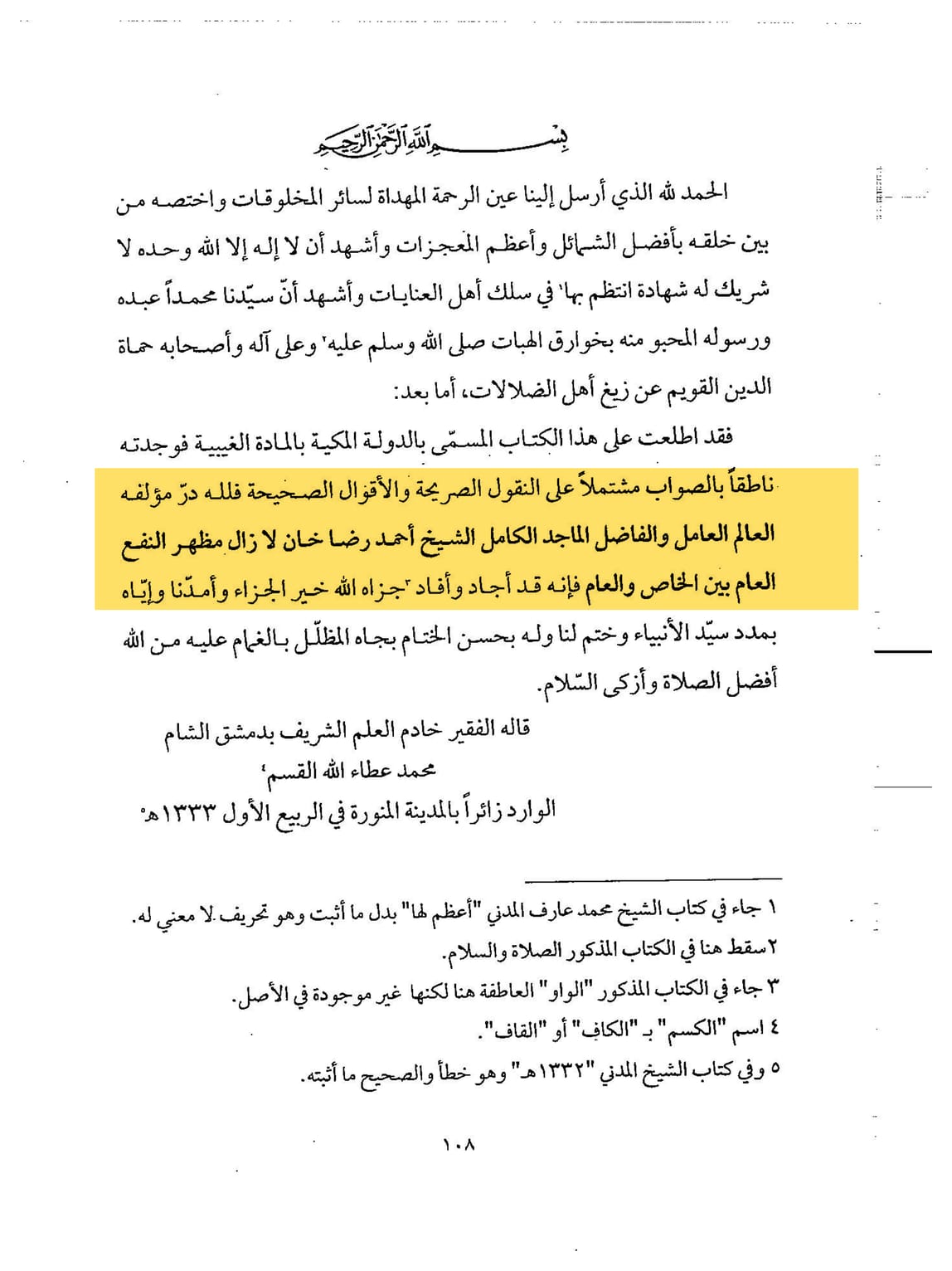
Scholars of Damascus visiting Madinah between 1330 and 1333 (1912–15) wrote endorsements of the same book — among them the Muftī of Damascus, Muĥammad Áţā’ Allāh al-Kasm, and Tāj al-Dīn, son of the great muĥaddith Badr al-Dīn al-Ĥasanī.23 The Muftī wrote:
فلله در مؤلفه العالم العامل والفاضل الماجد الكامل الشيخ أحمد رضا خان، لا زال مظهر النفع العام بين الخاص والعام، فإنه قد أجاد وأفاد
How excellent is its author, the learned and practising, the accomplished and noble Shaykh Aĥmad Riđā Khān — may he ever be a source of benefit to the elite and the common people alike. He has done excellently, and given benefit.24
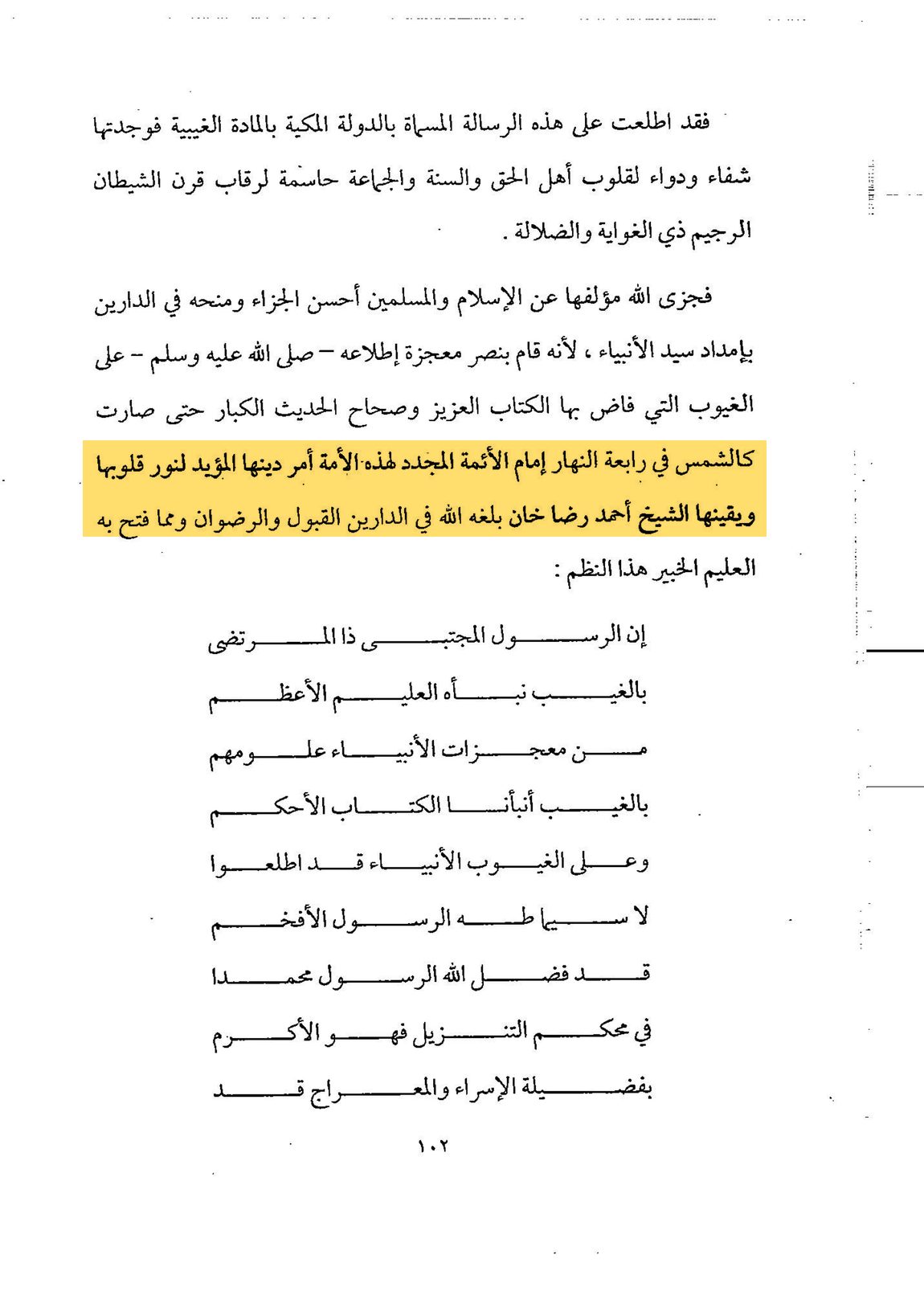
Mūsā Álī al-Shāmī al-Azharī, a scholar of al-Azhar of Syrian origin living in Madinah, wrote his endorsement in his own hand on 1 Rabīý al-Awwal 1330 (February 1912). He named its author:
إمام الأئمة المجدد لهذه الأمة أمر دينها المؤيد لنور قلوبها ويقينها الشيخ أحمد رضا خان
the imam of the imams, the renewer for this ummah of its religion, who strengthens the light of its hearts and its certainty, Shaykh Aĥmad Riđā Khān.25
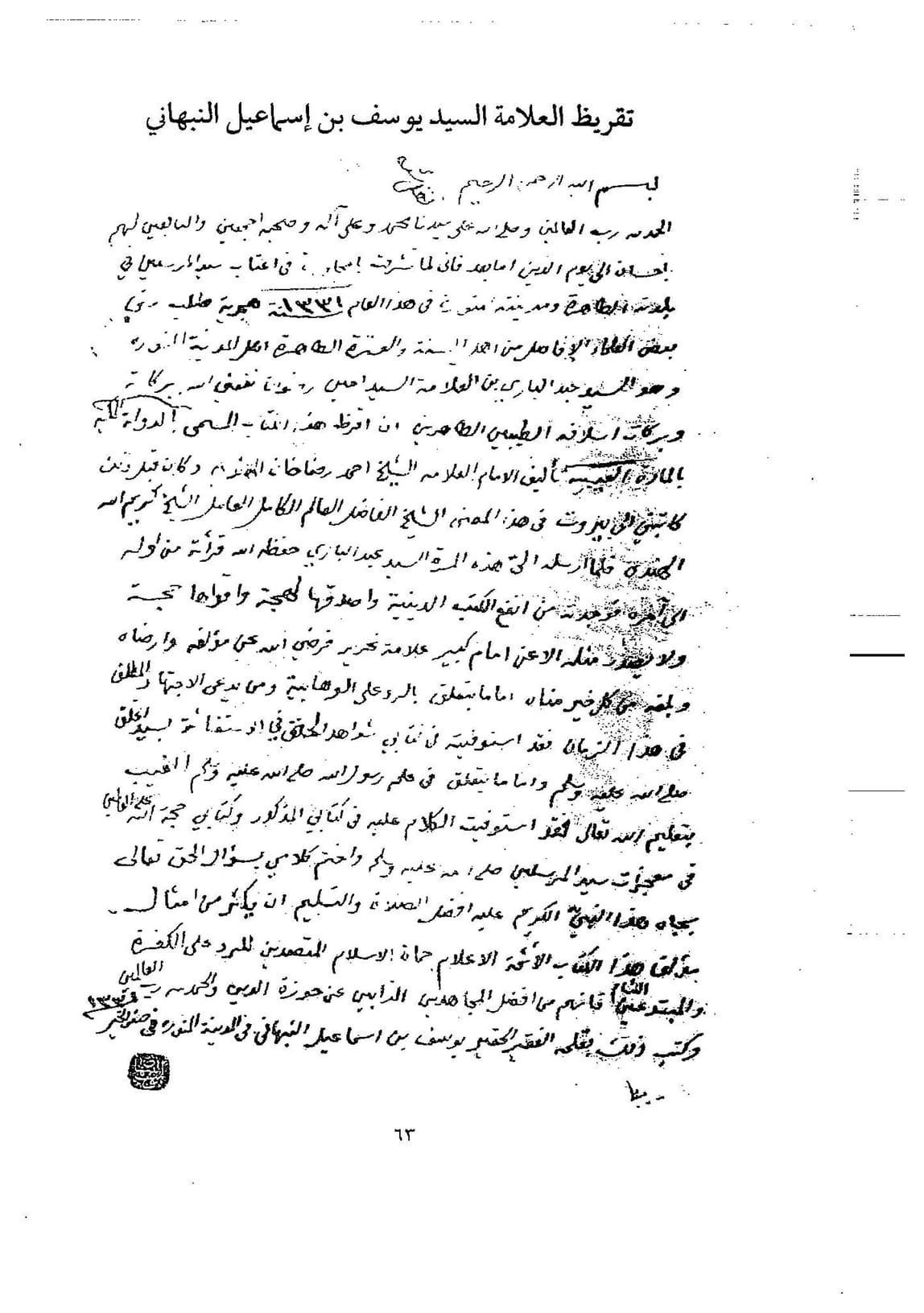
Al-Nabhānī’s endorsement in his own hand, Madinah, Şafar 1331, in Taqārīż Úlamā’ al-Shām, p. 63. Source 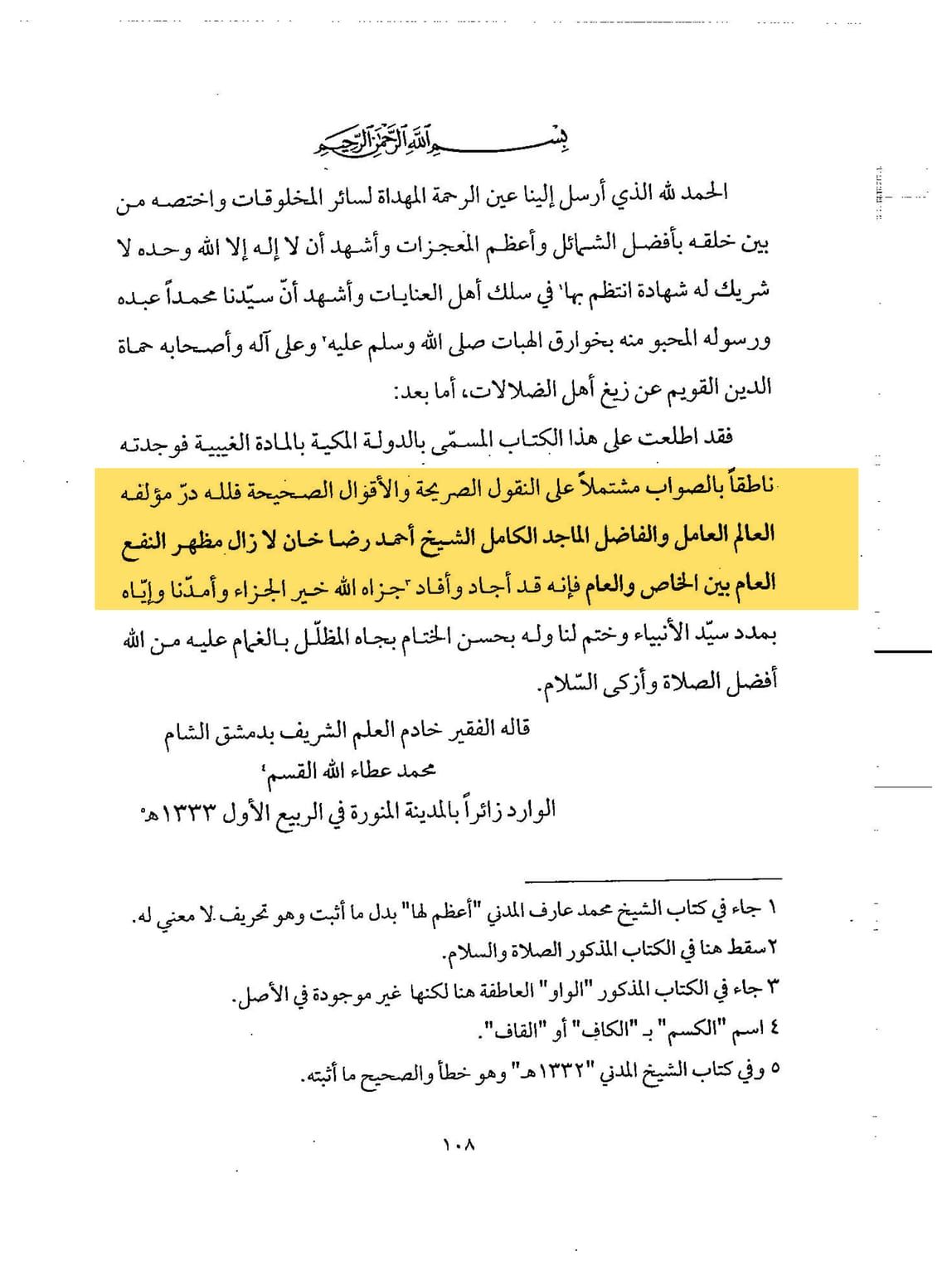
The Muftī of Damascus’s endorsement, Madinah, Rabīý al-Awwal 1333, ibid., p. 108 (highlight ours). Source 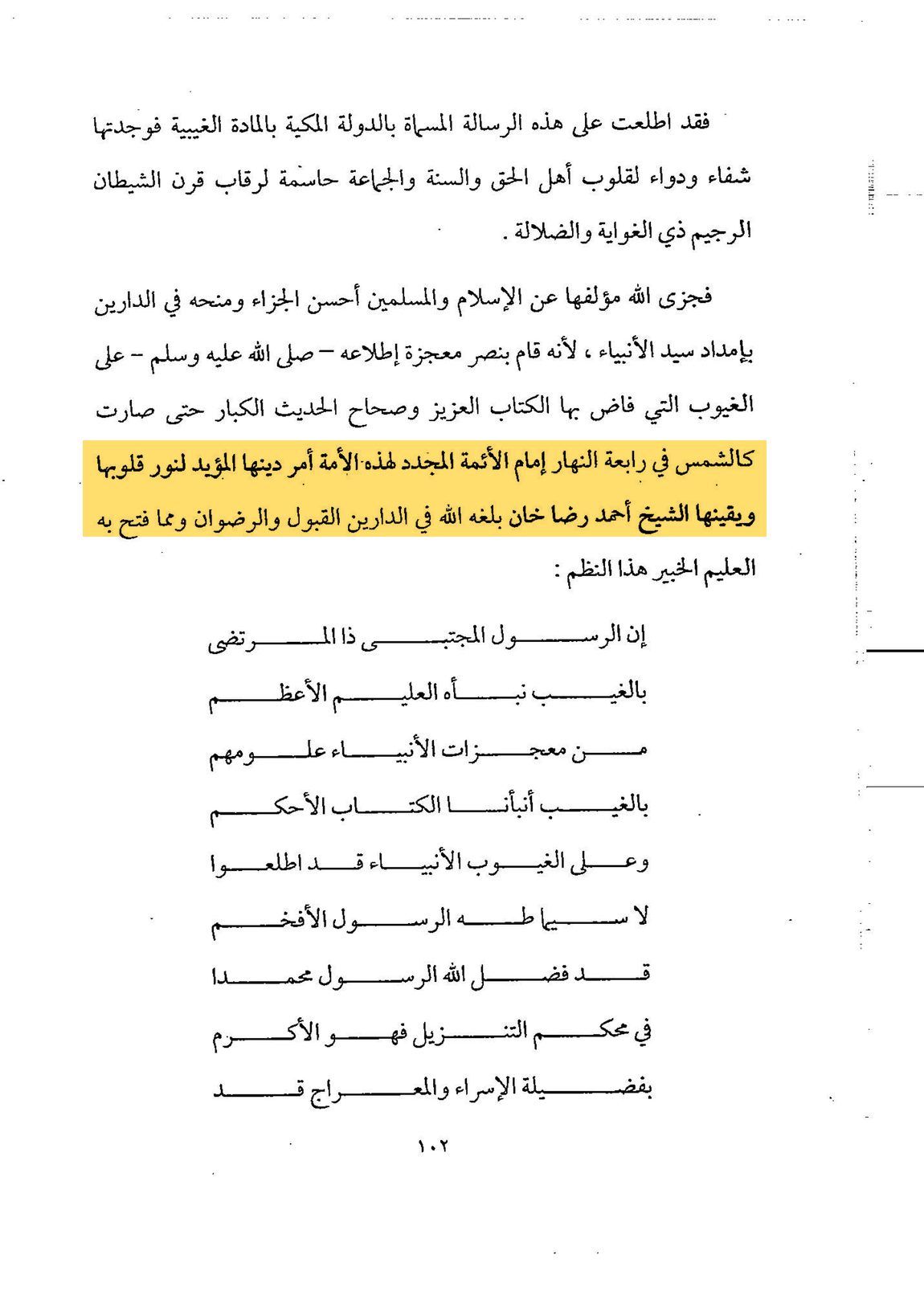
Mūsā Álī al-Shāmī’s endorsement, Madinah, Rabīý al-Awwal 1330, ibid., p. 102 (highlight ours). Source
Egypt
At al-Azhar, his fiqh is the subject of an MA thesis in the Faculty of Sharīáh and Law, al-Imām Aĥmad Riđā wa Atharuhu fi’l-Fiqh al-Ĥanafī (1997).26 In 1999 Ĥāzim Muĥammad Aĥmad Maĥfūż, a lecturer in al-Azhar’s Department of Urdu, compiled a memorial volume for the eightieth anniversary of his death, with contributions from professors of al-Azhar and Ain Shams.27 The Egyptian writer and publisher Muĥammad Khālid Thābit, who had first known him only through his critics, read his works and called him:
إمام أهل السنة في قرننا العشرين، وإمام المحبين لحبيب رب العالمين
the imam of Ahl al-Sunnah in our twentieth century, and the imam of the lovers of the Beloved of the Lord of the worlds ﷺ.28
Cairo and Abu Dhabi publishers have printed his Arabic works in recent years.29
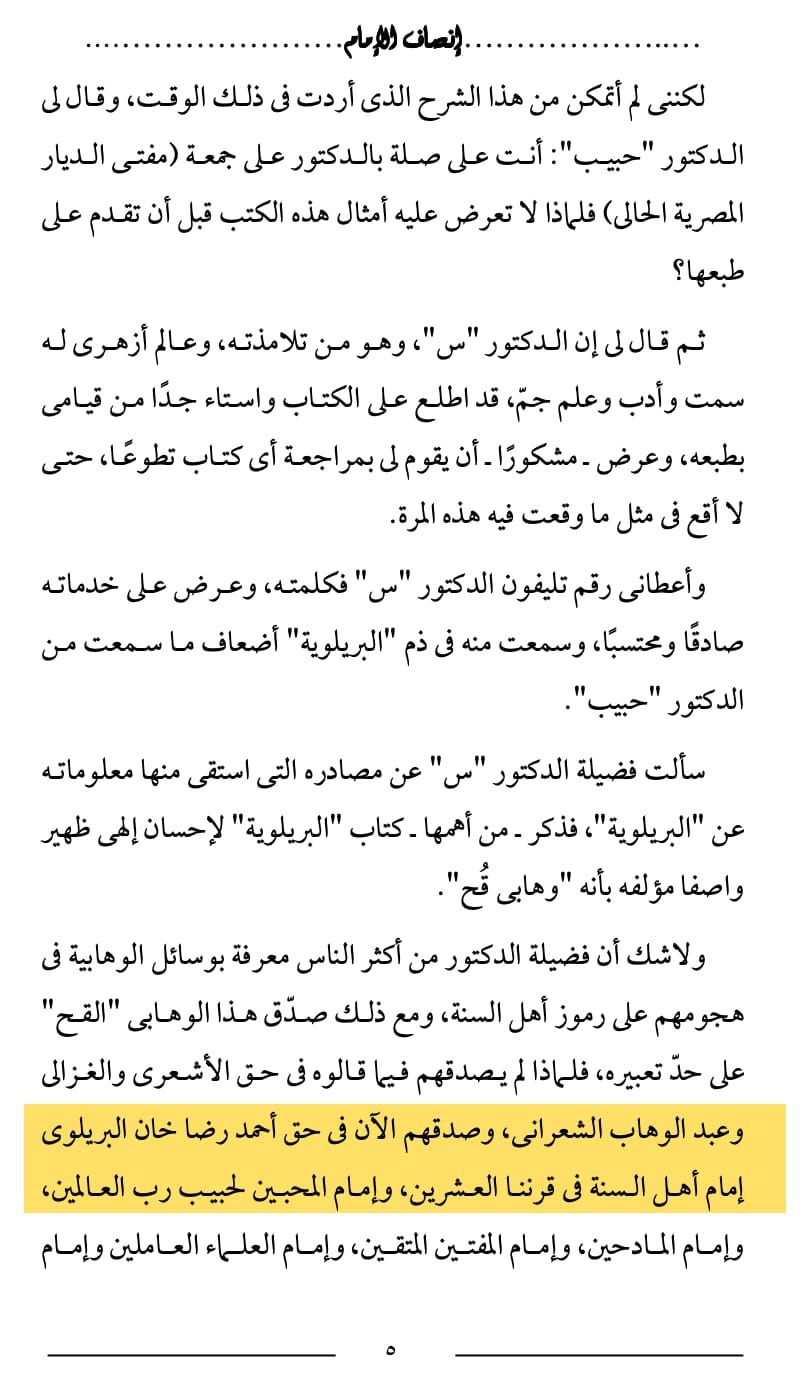
Muĥammad Khālid Thābit, Inşāf al-Imām (Cairo: Dār al-Muqaţţam), p. 5 (highlight ours). Source
Türkiye and the Ottomans
Reception in Türkiye
In Türkiye, Alahazrat’s works are kept in print, translated, studied and cited — by one of the country’s best-known Sunni publishers, by its national Islamic encyclopedia, by its universities and by its scholars.
Hakikat Kitabevi
Hakikat Kitabevi of Istanbul, the publishing house founded by Hüseyin Hilmi Işık, has kept three of his Arabic works in print since its first Istanbul offset editions of 1395 AH / 1975:30
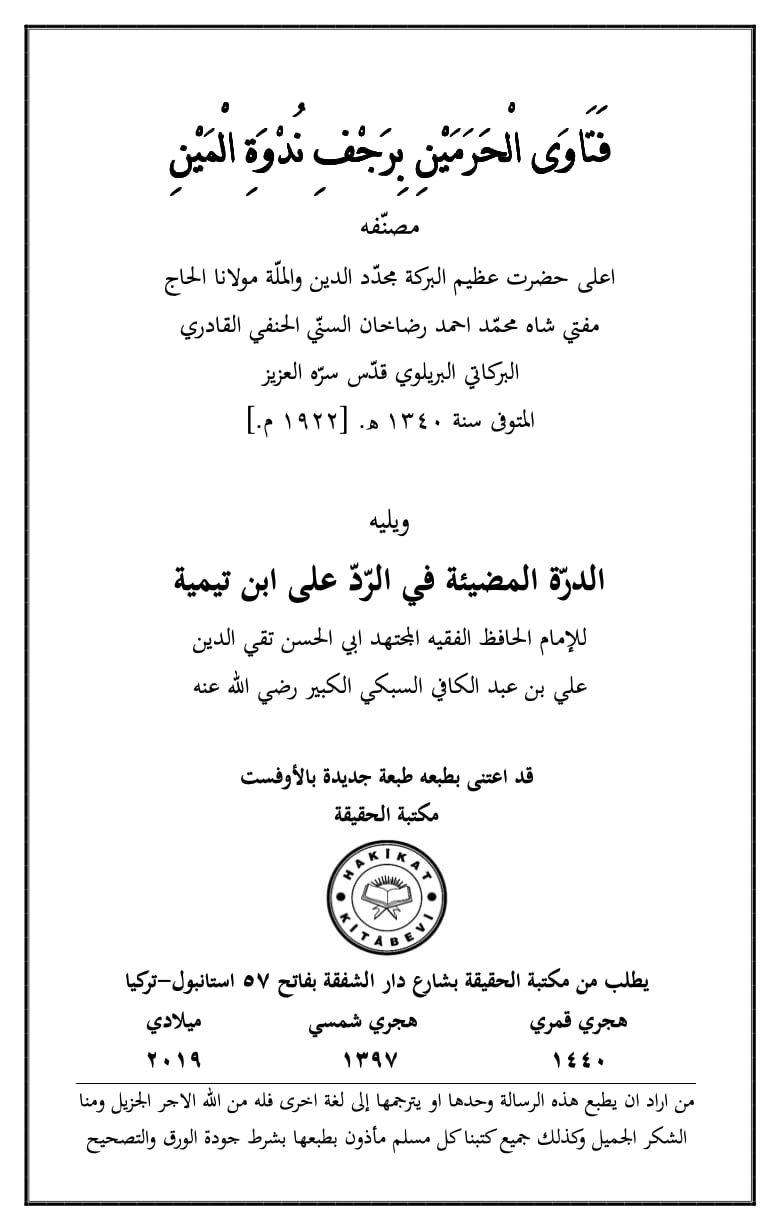
- Fatāwā al-Ĥaramayn bi Rajf Nadwat al-Mayn, his answers to twenty-eight questions on the Nadwah (2019 edition);31
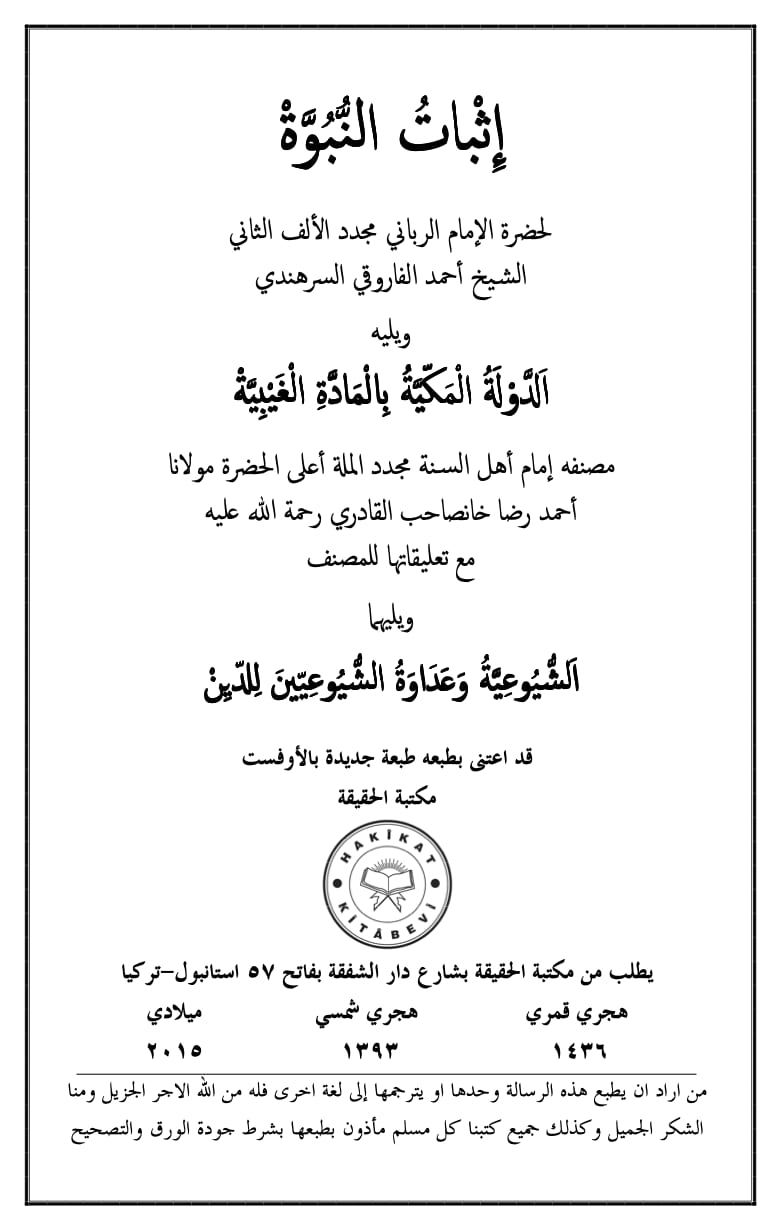
- Al-Dawlat al-Makkiyyah bi’l Māddat al-Ghaybiyyah, with his own notes and the endorsements of the scholars of the two sanctuaries (2015 edition);32
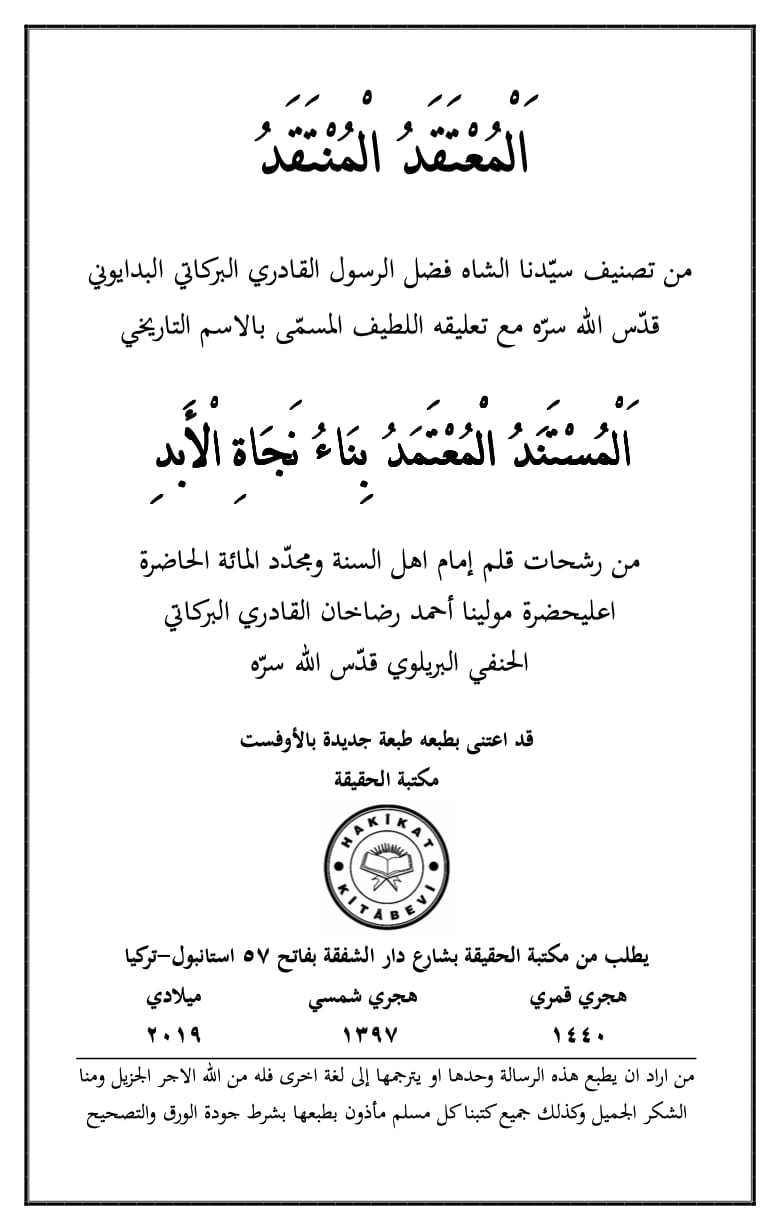
- Al-Mustanad al-Mútamad Binā’ Najāt al-Abad, his commentary on Imām Fađl ar-Rasūl al-Badāyūnī’s Al-Mútaqad al-Muntaqad (2019 edition).33
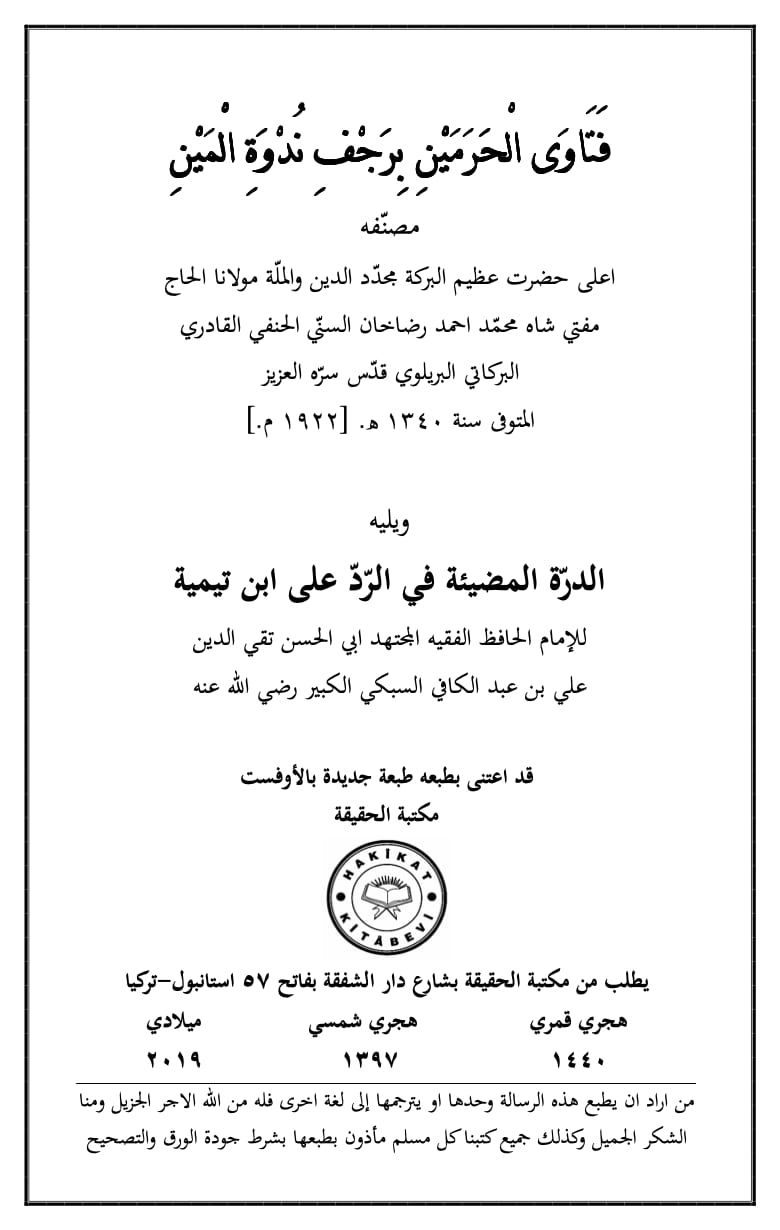
Fatāwā al-Ĥaramayn — title page. Hakikat Kitabevi, 1440 AH / 2019. Source 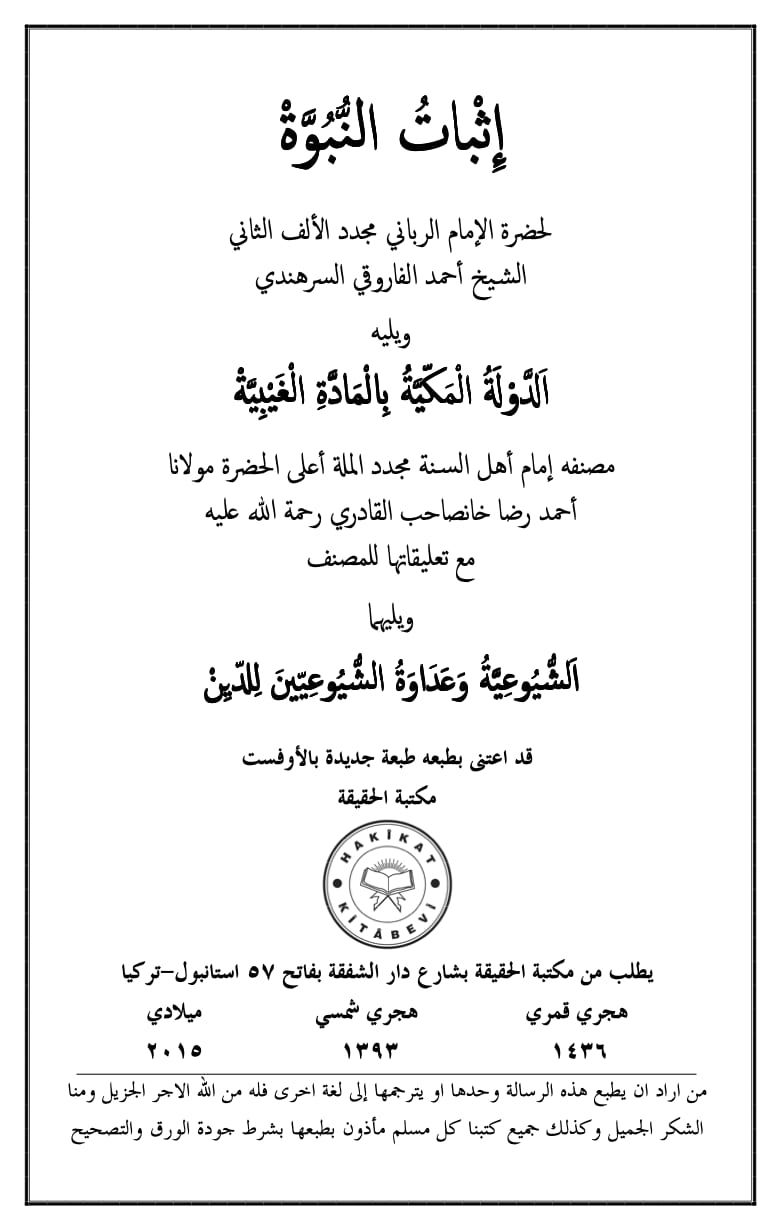
Ithbāt al-Nubuwwah, followed by al-Dawlat al-Makkiyyah — title page. Hakikat Kitabevi, 1436 AH / 2015. Source 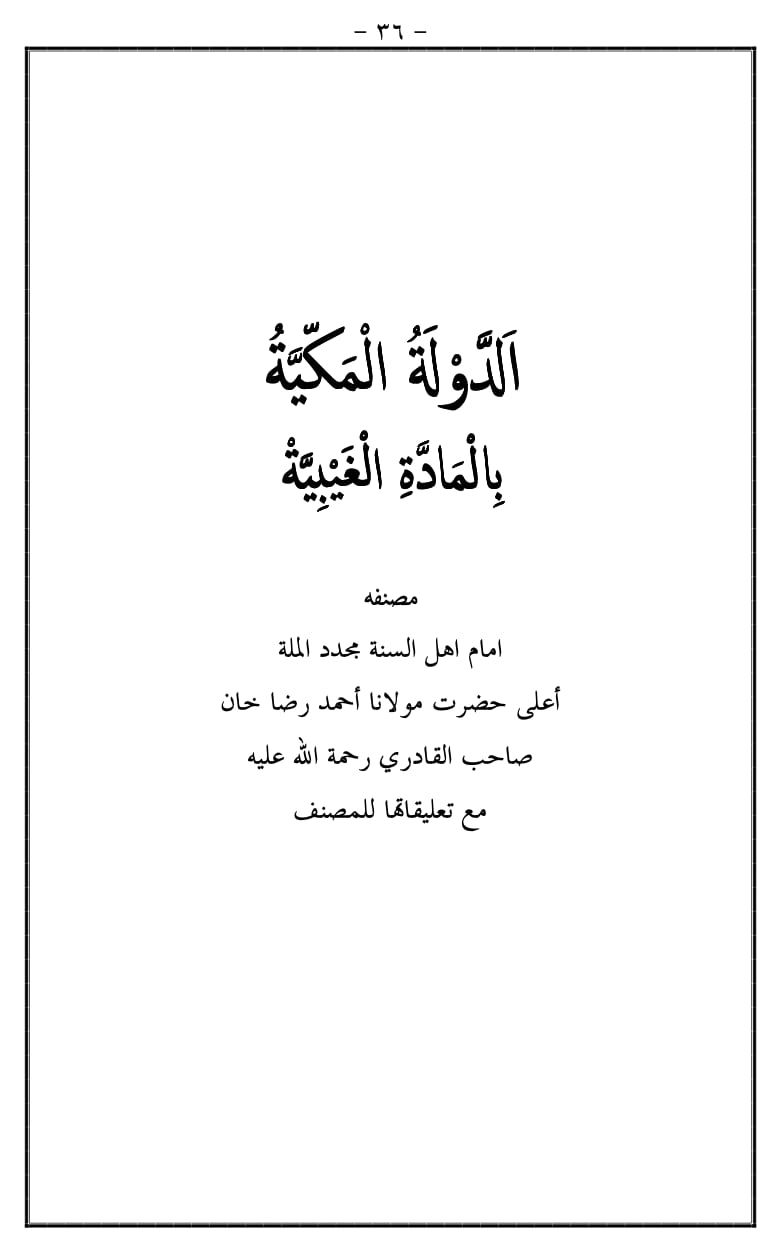
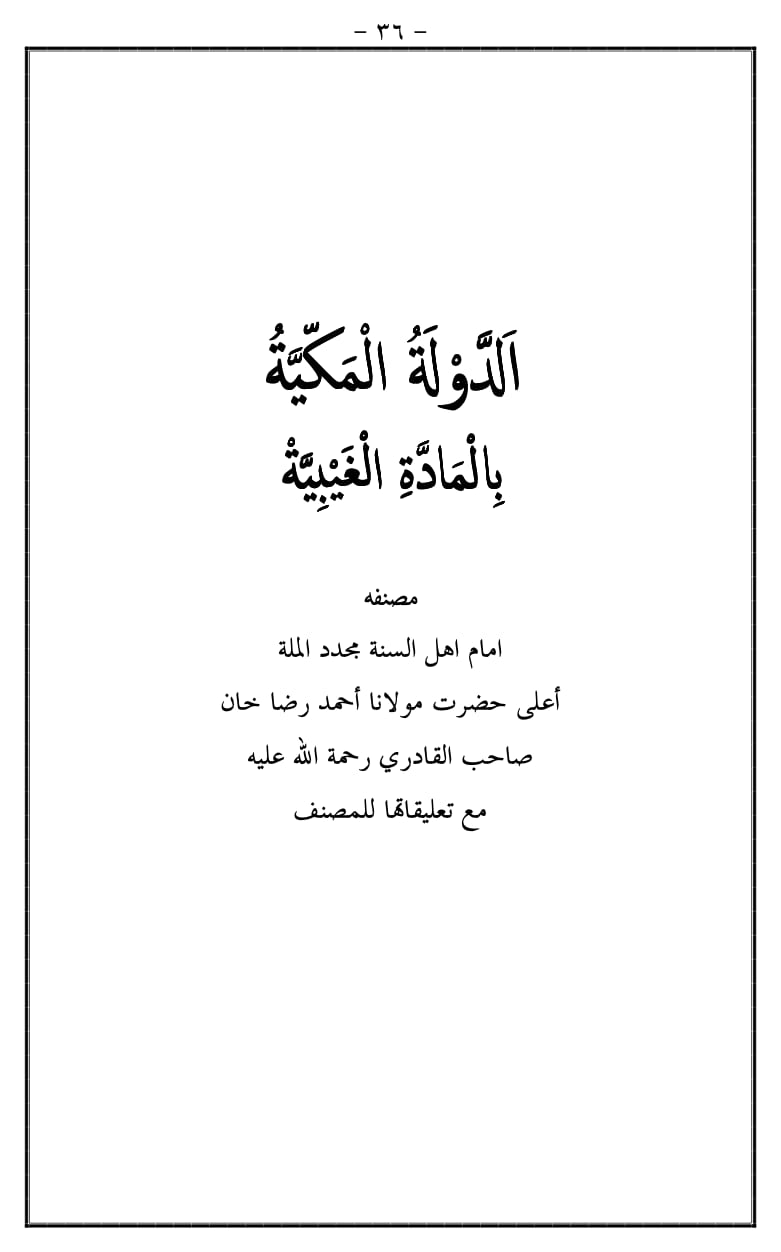
al-Dawlat al-Makkiyyah, p. 36: “by the Imam of Ahl al-Sunnah, Reviver of the Millah, Aʿlā Ĥađrat”. Source 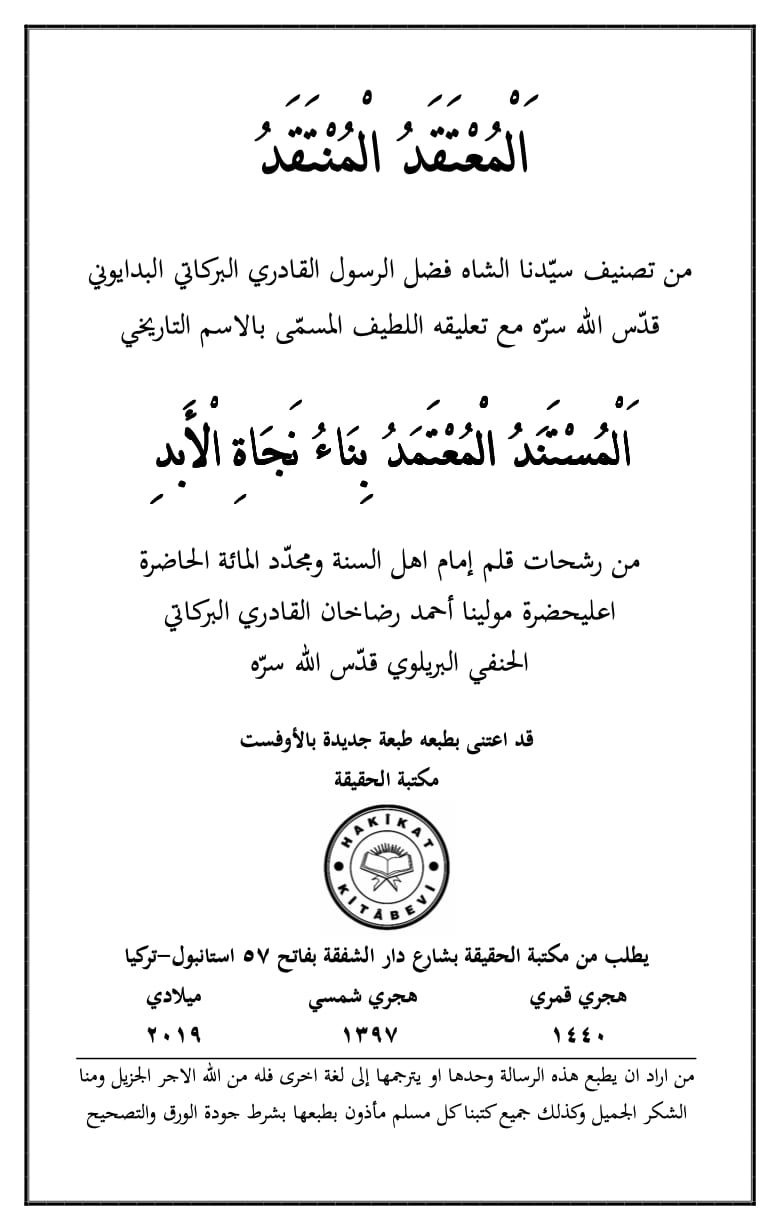
al-Mútaqad al-Muntaqad with al-Mustanad al-Mútamad — title page. Hakikat Kitabevi, 1440 AH / 2019. Source
Its best-known Turkish works cite him by name:
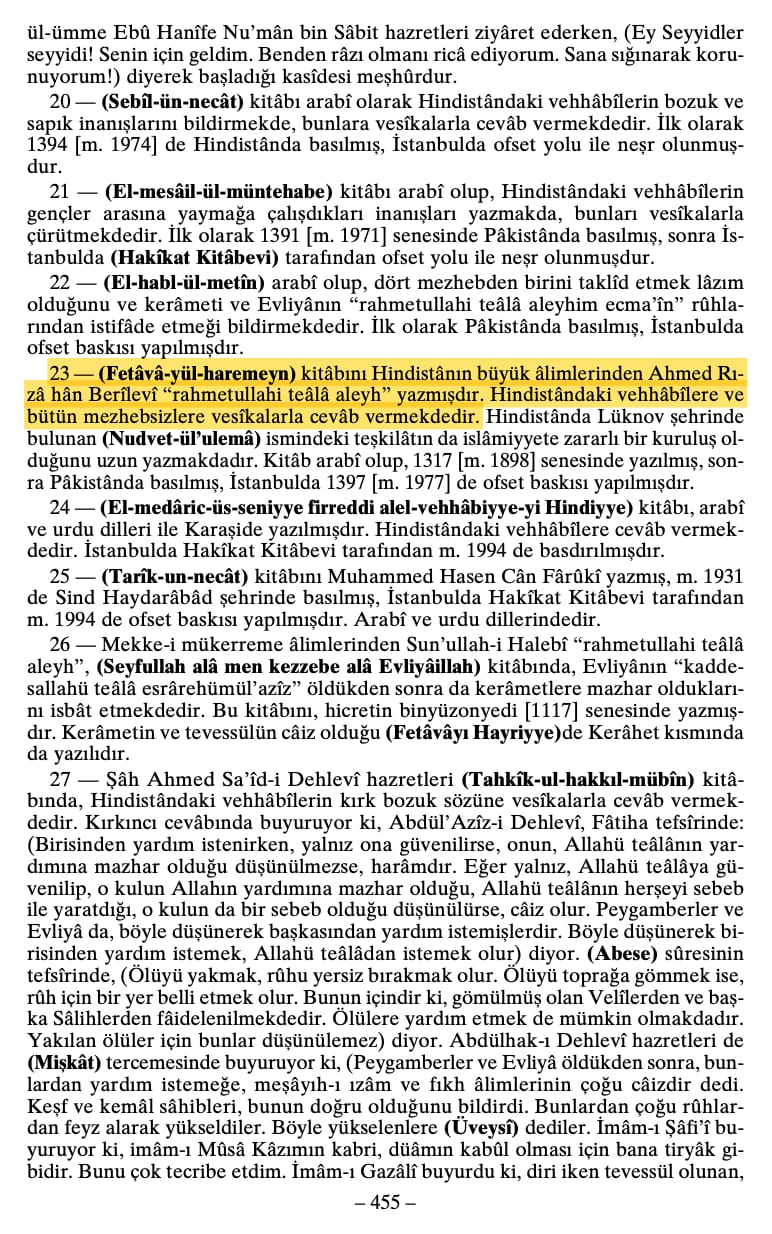
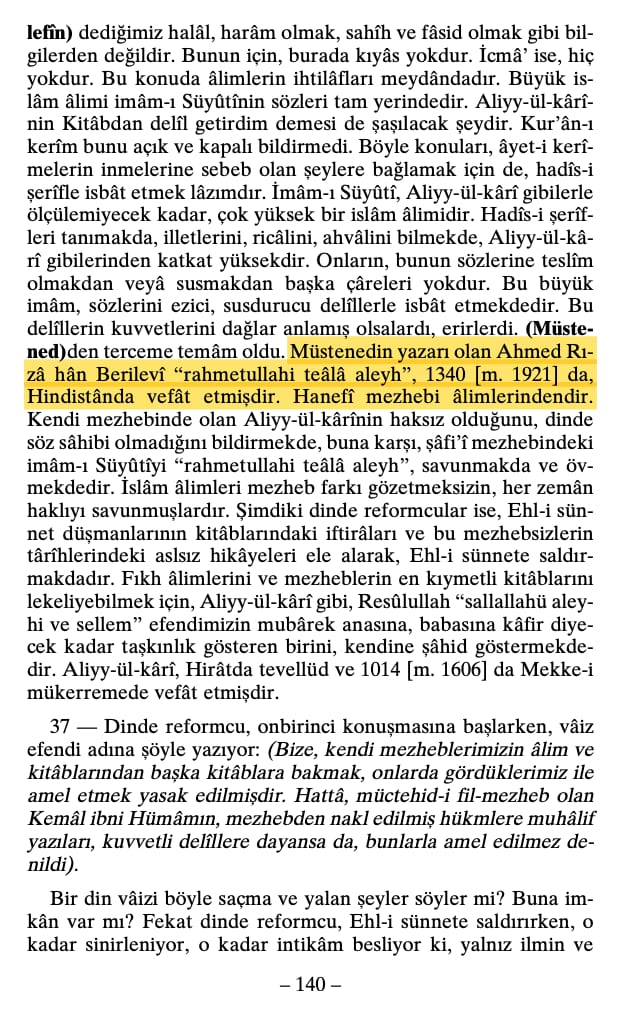
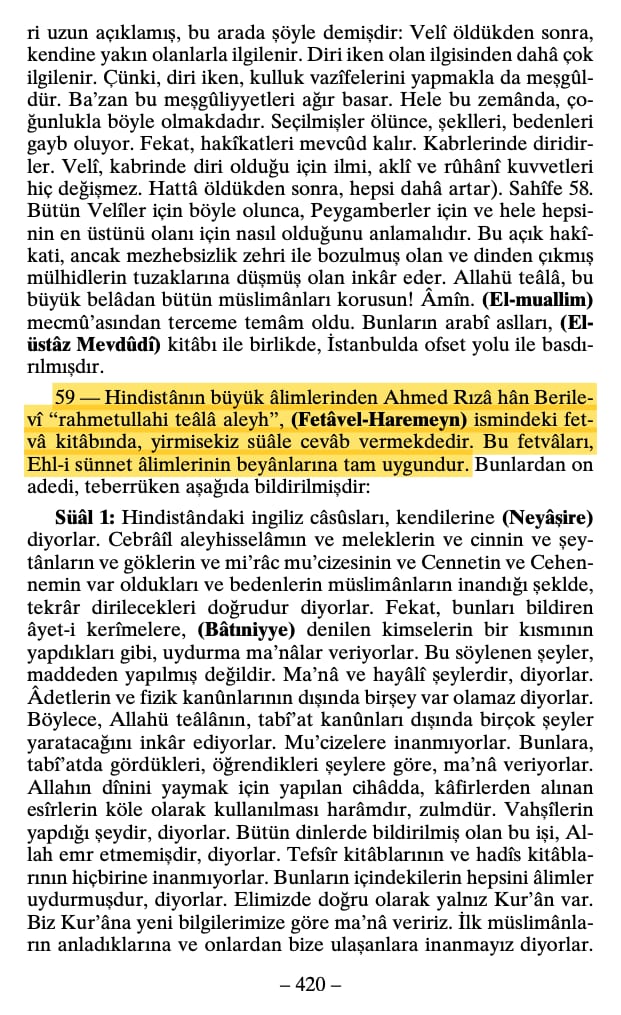
(Fetâvâ-yül-haremeyn) kitâbını Hindistânın büyük âlimlerinden Ahmed Rızâ hân Berîlevî “rahmetullahi teâlâ aleyh” yazmışdır. Hindistândaki vehhâbîlere ve bütün mezhebsizlere vesîkalarla cevâb vermekdedir.
The book Fatāwā al-Ĥaramayn was written by Ahmad Raza Khan Barelvi, one of the great scholars of India — may Allah have mercy on him. It answers the Wahhabis of India and all who reject the madhhabs with documented proofs.34
Müstenedin yazarı olan Ahmed Rızâ hân Berilevî “rahmetullahi teâlâ aleyh”, 1340 [m. 1921] da, Hindistânda vefât etmişdir. Hanefî mezhebi âlimlerindendir.
The author of al-Mustanad, Ahmad Raza Khan Barelvi — may Allah have mercy on him — passed away in India in 1340 [1921]. He is one of the scholars of the Hanafi school.35
The same book translates ten of his twenty-eight Fatāwā al-Ĥaramayn into Turkish, introducing them: “Bu fetvâları, Ehl-i sünnet âlimlerinin beyânlarına tam uygundur” — “these fatwas fully accord with the statements of the scholars of Ahl al-Sunnah.”36
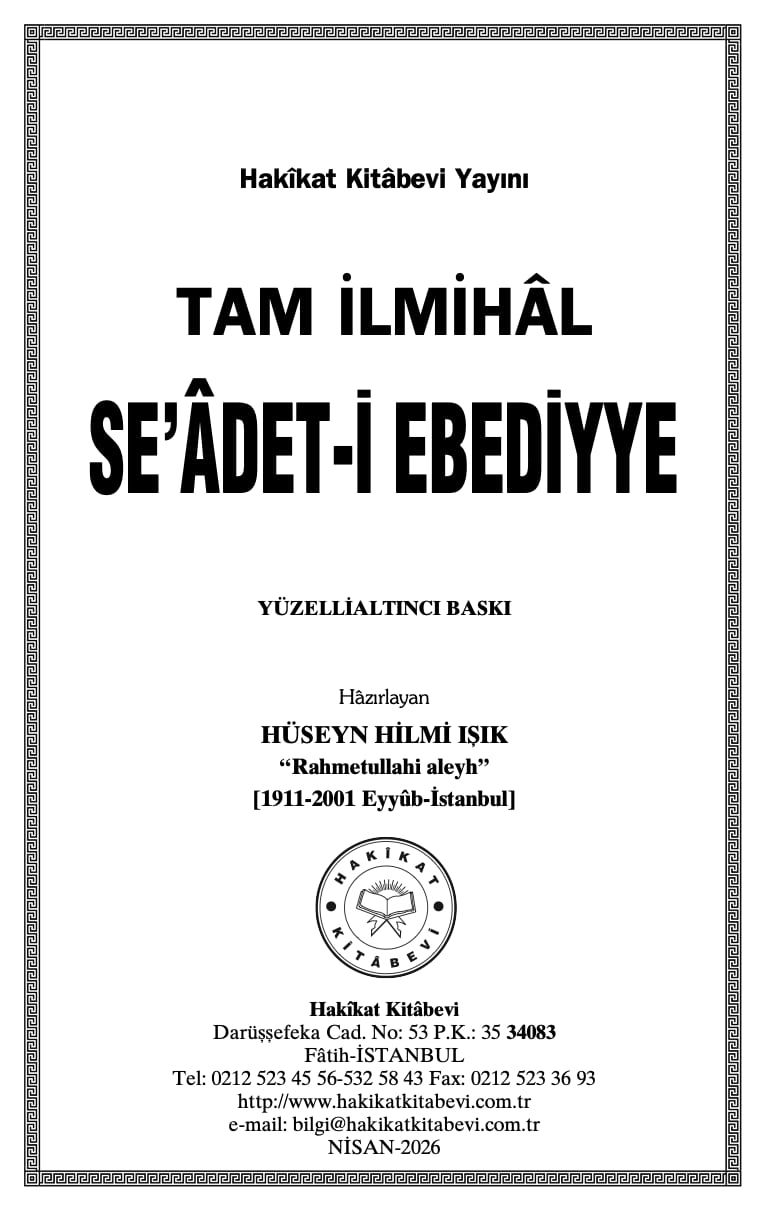
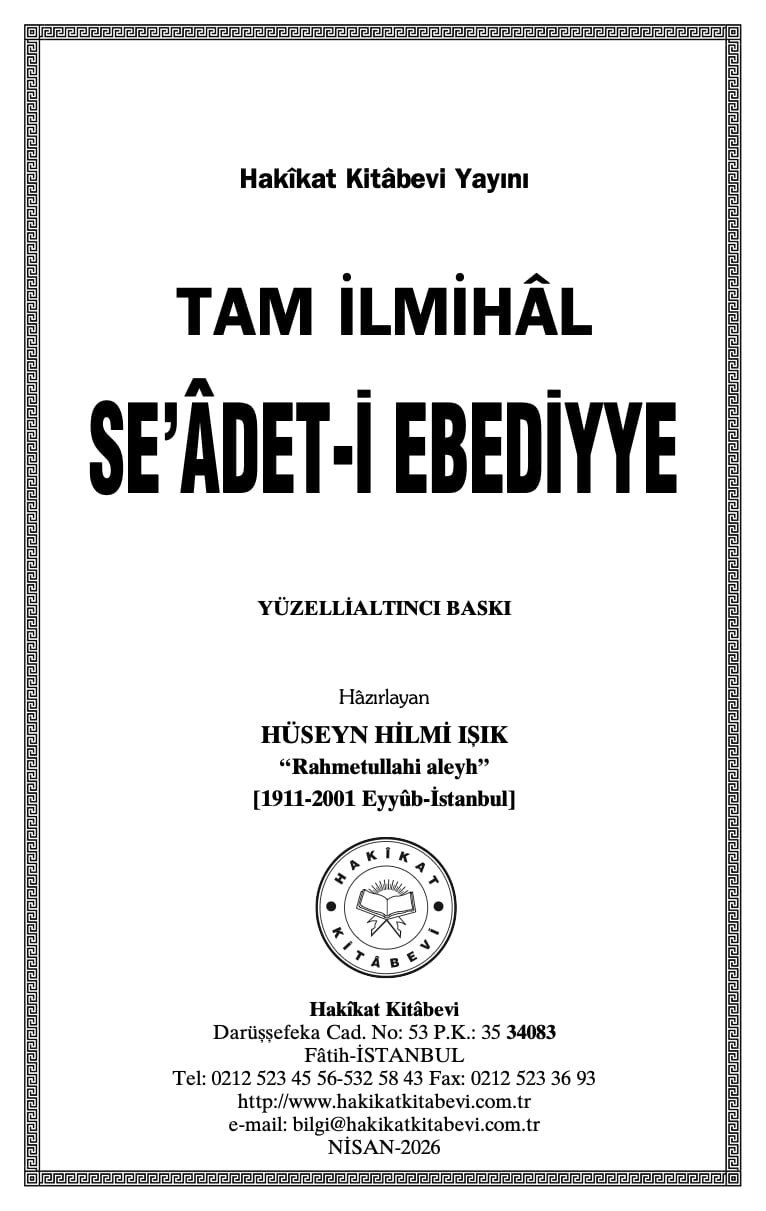
Tam İlmihâl Se’âdet-i Ebediyye — title page. Hakikat Kitabevi, 156th printing, April 2026. Source 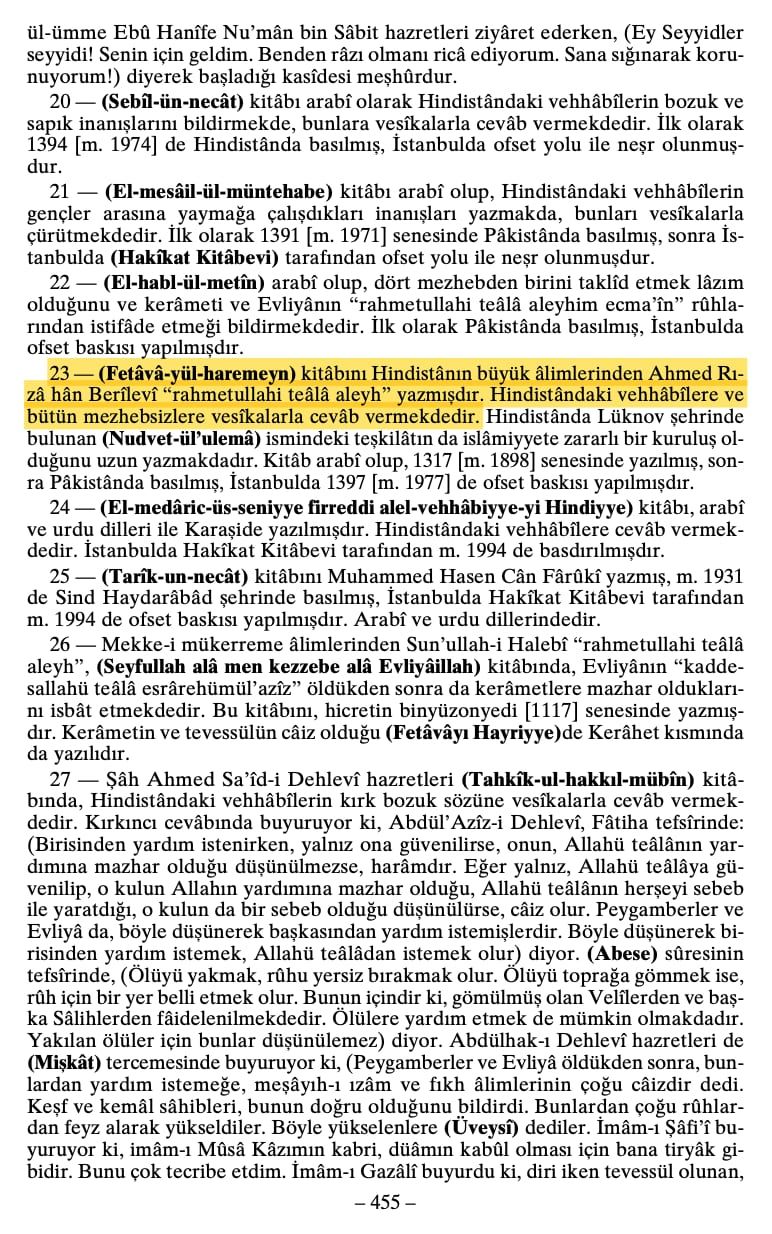
Se’âdet-i Ebediyye, p. 455 (highlight ours). Source 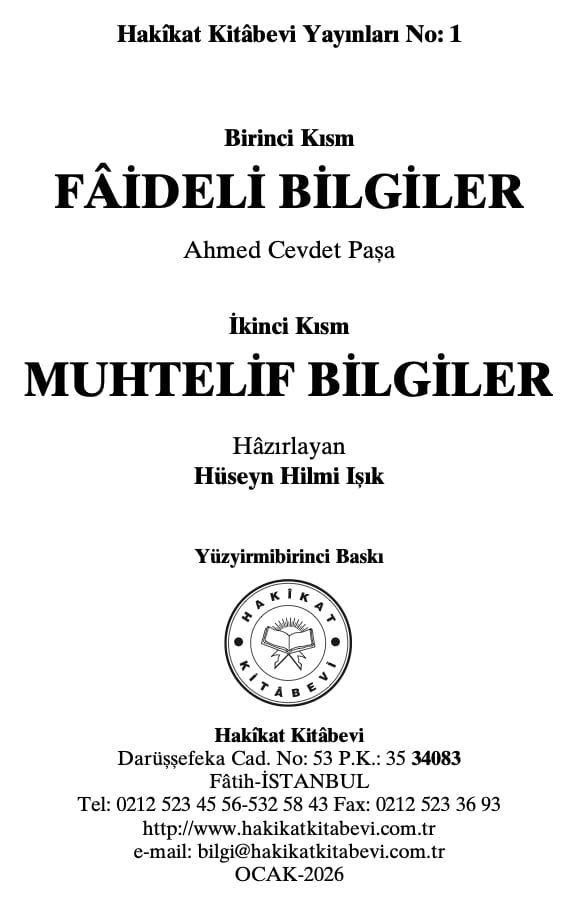
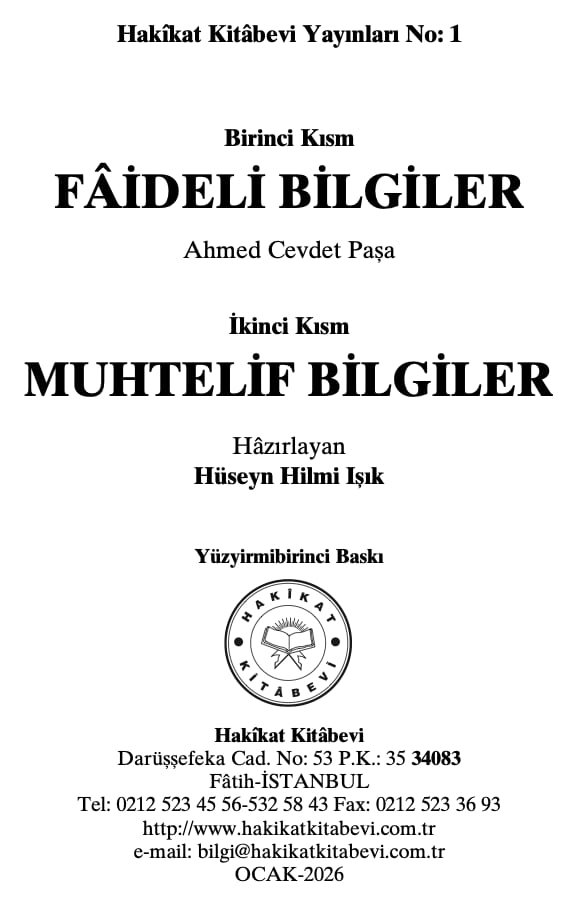
Fâideli Bilgiler — title page. Hakikat Kitabevi, 121st printing, January 2026. Source 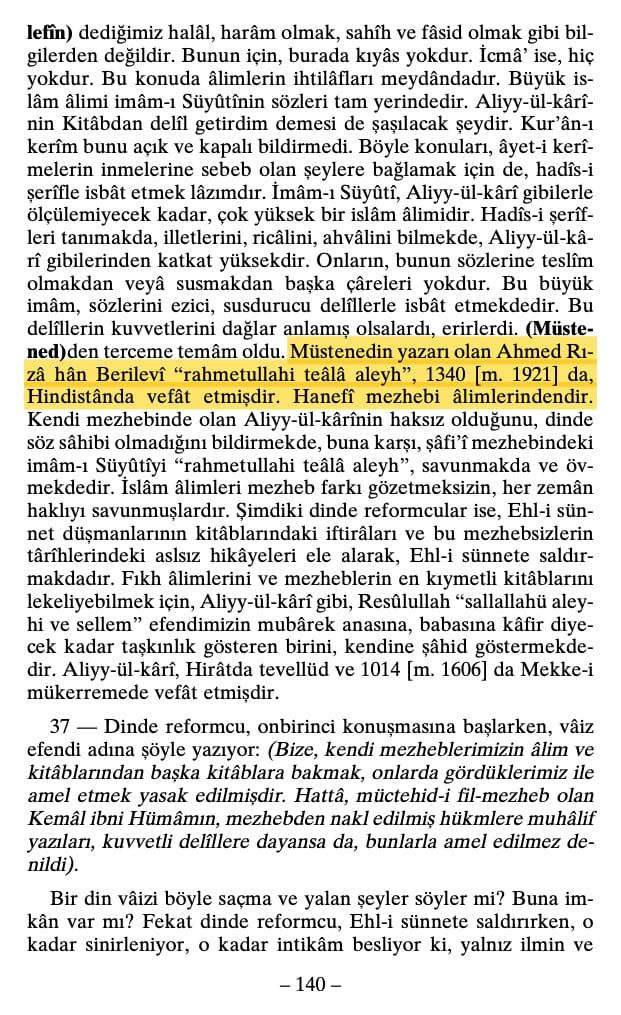
Fâideli Bilgiler, p. 140 (highlight ours). Source 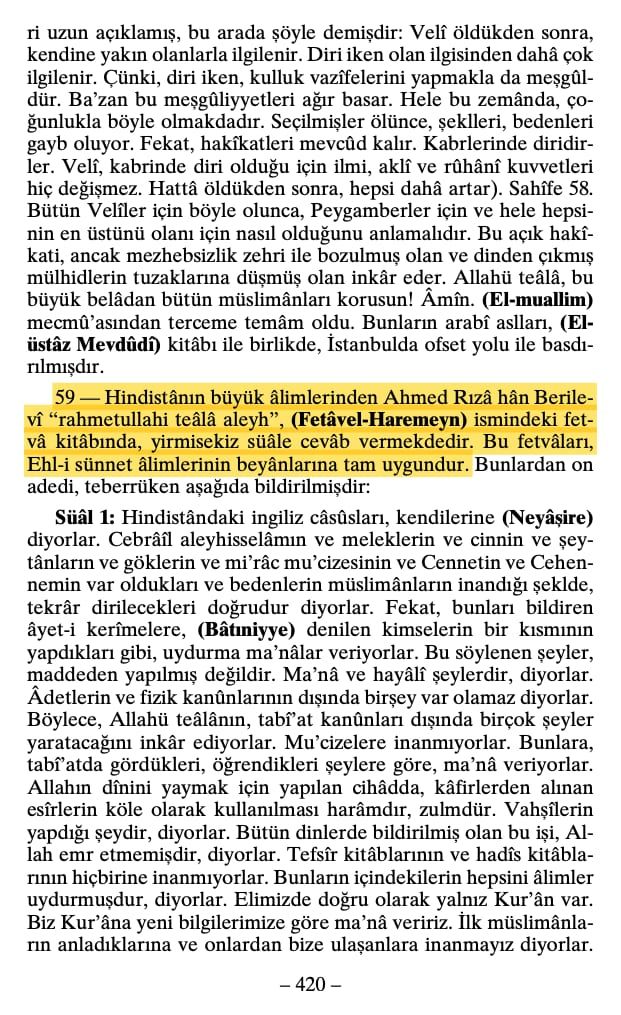
Fâideli Bilgiler, p. 420 (highlight ours). Source
TDV İslâm Ansiklopedisi
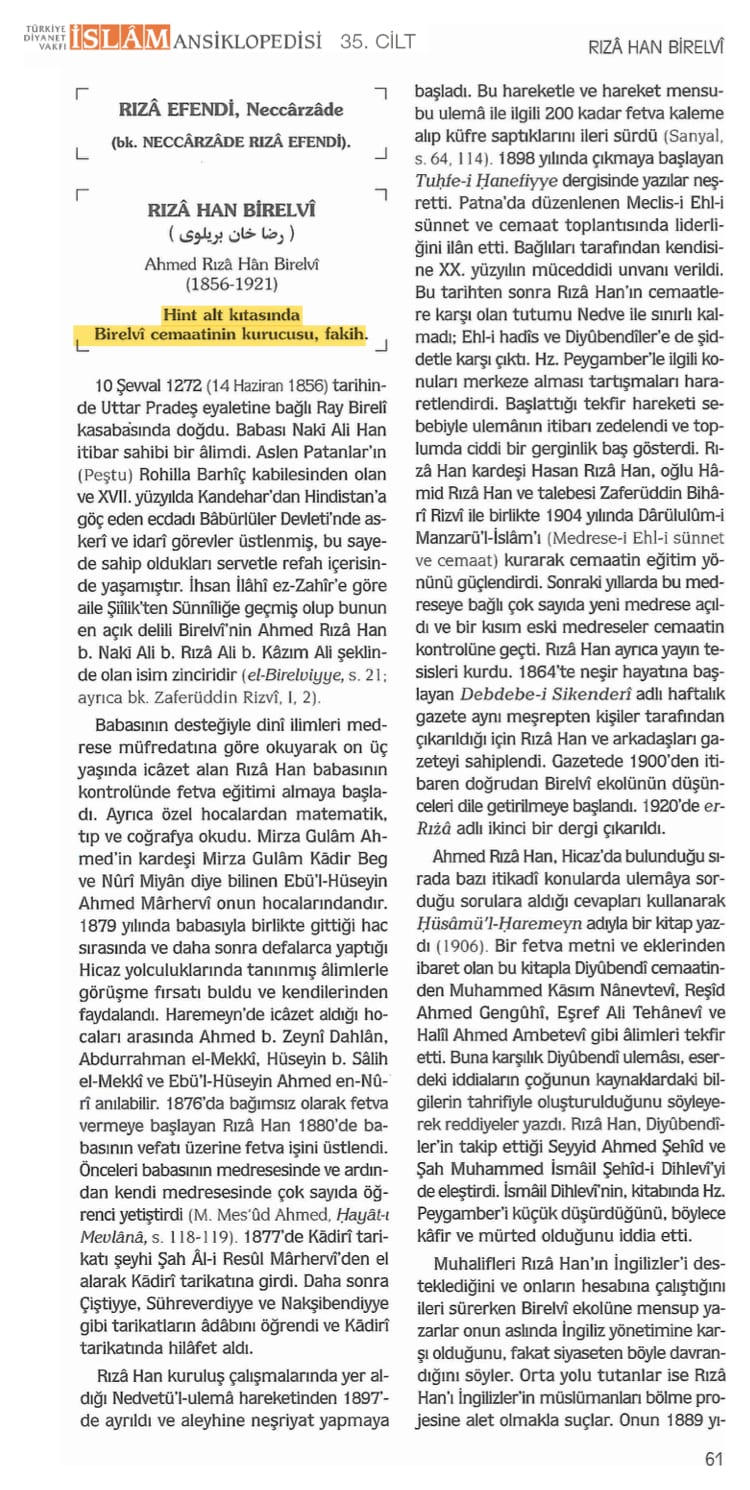
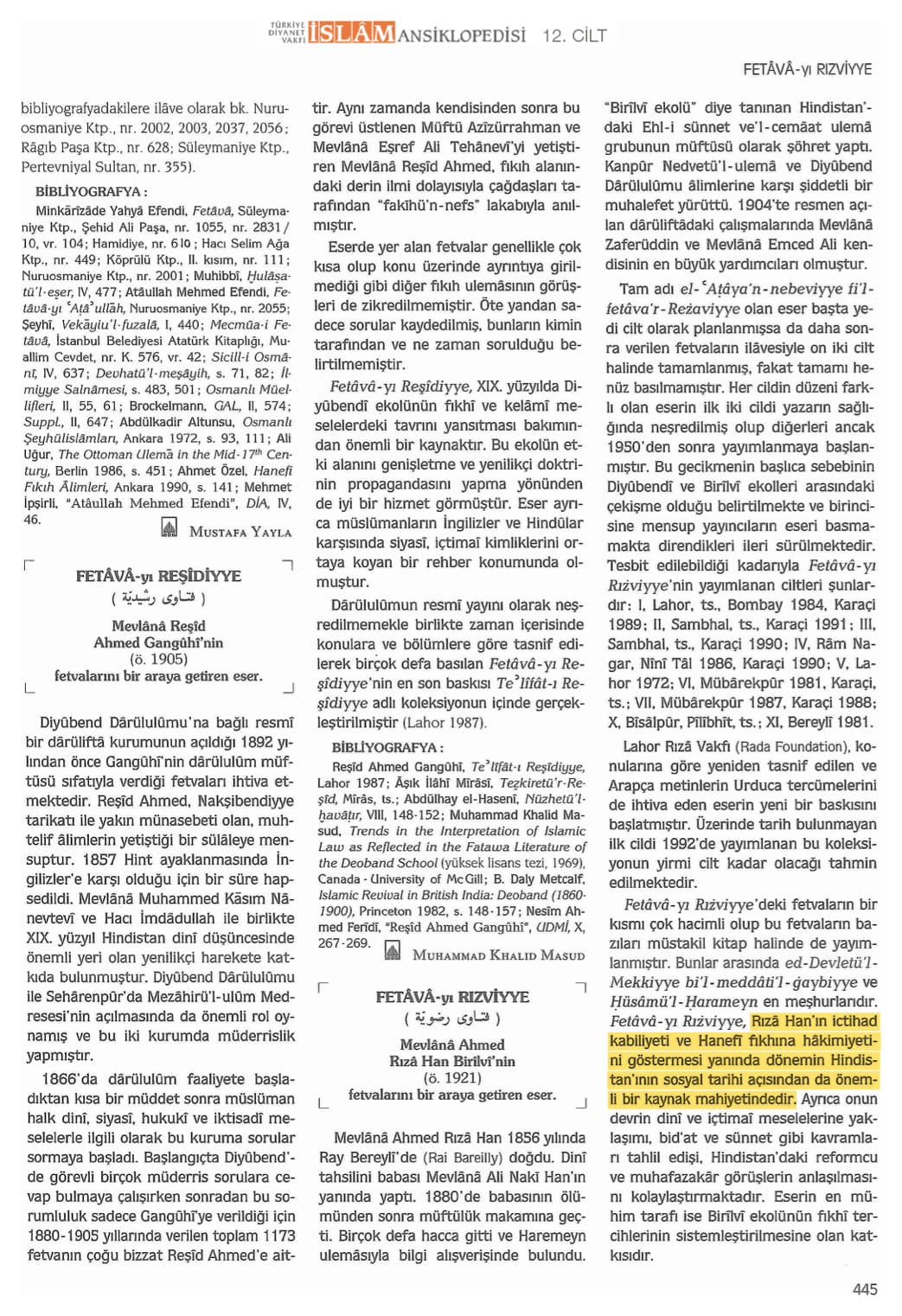
Türkiye’s national Islamic encyclopedia gives him a full entry,37 and a separate entry on his collected fatwas, which says:
Fetâvâ-yı Rıżviyye, Rızâ Han’ın ictihad kabiliyeti ve Hanefî fıkhına hâkimiyetini göstermesi yanında dönemin Hindistan’ının sosyal tarihi açısından da önemli bir kaynak mahiyetindedir.
The Fatāwā Riđawiyyah shows Raza Khan’s capacity for ijtihad and his mastery of Hanafi fiqh, and is also an important source for the social history of India in his time.38
Turkish universities
His collection of na’t, Ĥadā’iq e Bakhshish, has been translated into Turkish as Mağfiret Bahçeleri by Hafız Aamir Ali and Dr Recep Durgun of Selçuk University. Durgun’s study of it calls it “en makbul na’t kitabı” — the most esteemed book of na’t — after which its author was called “Hassan-ı Hindi, na’t şairlerinin imamı”, the Ĥassān of India and the imam of na’t poets. It concludes:39
…na’tlarında asla ihtiyatı elden bırakmamış, abd ve ilah arasındaki sınırı aşmamıştır.
…in his na’t he never abandoned caution, and never crossed the line between the servant and God.
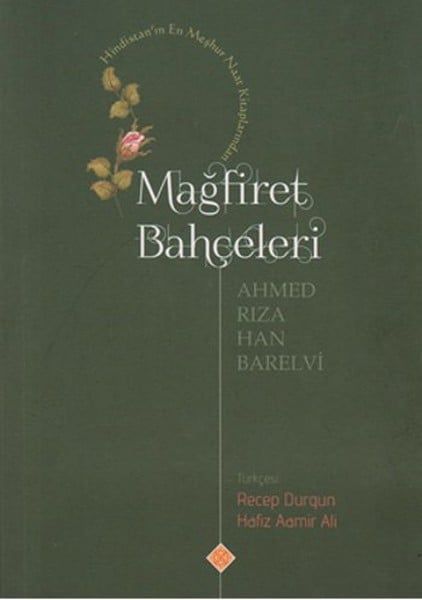
Mağfiret Bahçeleri, trans. Recep Durgun and Hafız Aamir Ali (Konya: Kömen Yayınları, 2016), front cover. 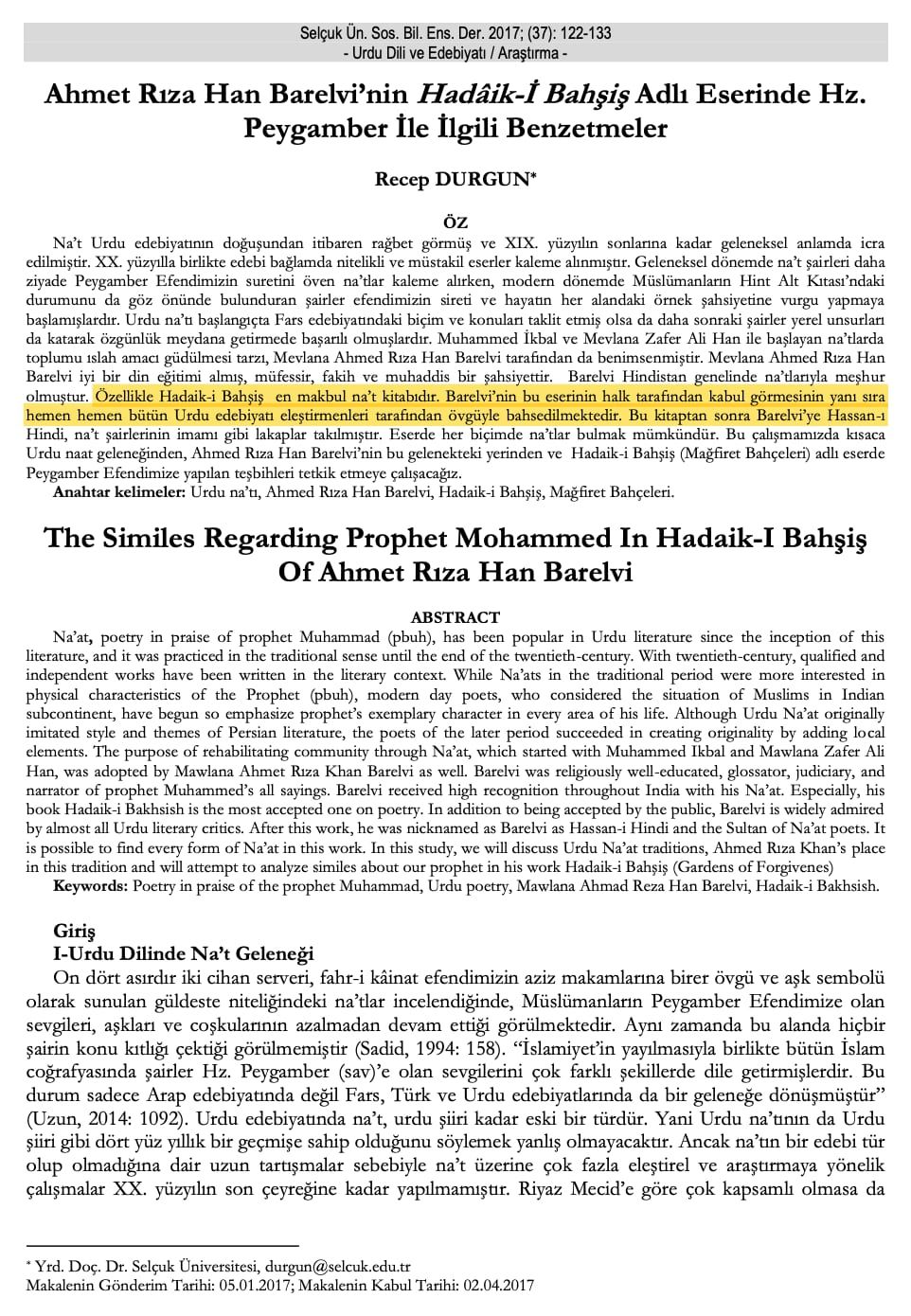
Durgun, Selçuk Üniv. Sosyal Bilimler Enstitüsü Dergisi 37 (2017), p. 122 (highlight ours). Source
Turkish scholars
On the passing of Taj al-Shari’ah Mufti Muhammad Akhtar Raza Khan al-Azhari رحمه الله in 2018, Cübbeli Ahmet Hoca wrote of his great-grandfather:
Hindistan’da bulunan Ehli Sünnet ve’l-Cemaat’in lideri ve büyük müceddidi Ahmet Rızâ Hân el-Kâdirî Hazretleri…
Ahmad Raza Khan al-Qadiri, the leader and great mujaddid of Ahl al-Sunnah wa’l-Jama’ah in India…40
Türkiye and the Ottomans
His fatwa of 1913 in support of the Ottomans
Turkish readers may know of Alahazrat’s 1920 fatwa on the caliphate, which the TDV İslâm Ansiklopedisi summarises as holding “Türkler’in hilâfet makamını temsil etmediğine” — that the Turks did not hold the office of the caliphate.41 What that fatwa says, and what he did for the Turks, is set out below from his own writings.
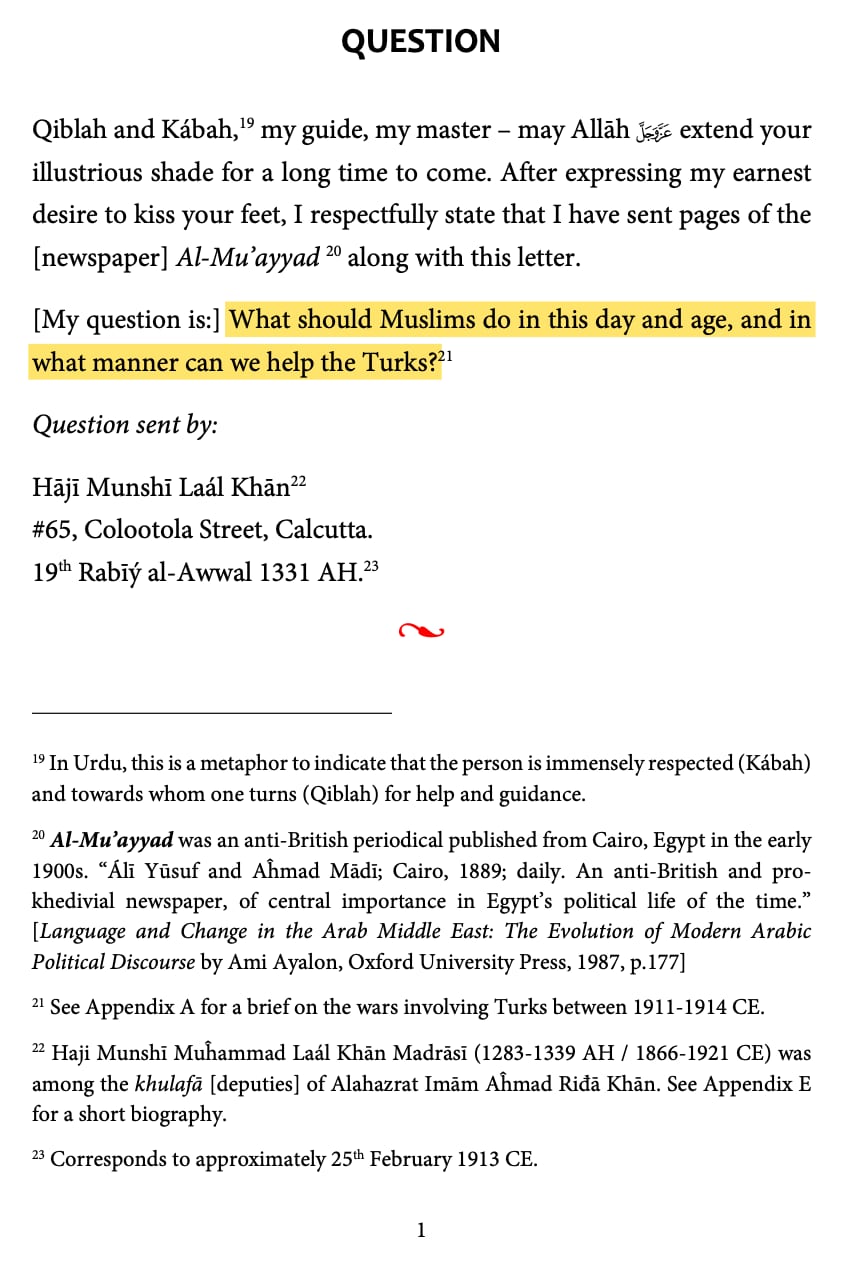
During the Balkan Wars, his khalifa Haji Munshi La‘l Khan of Calcutta sent him six issues of the Cairo newspaper al-Mu’ayyad with a question dated 19 Rabī‘ al-Awwal 1331 — about 25 February 1913:
What should Muslims do in this day and age, and in what manner can we help the Turks?42
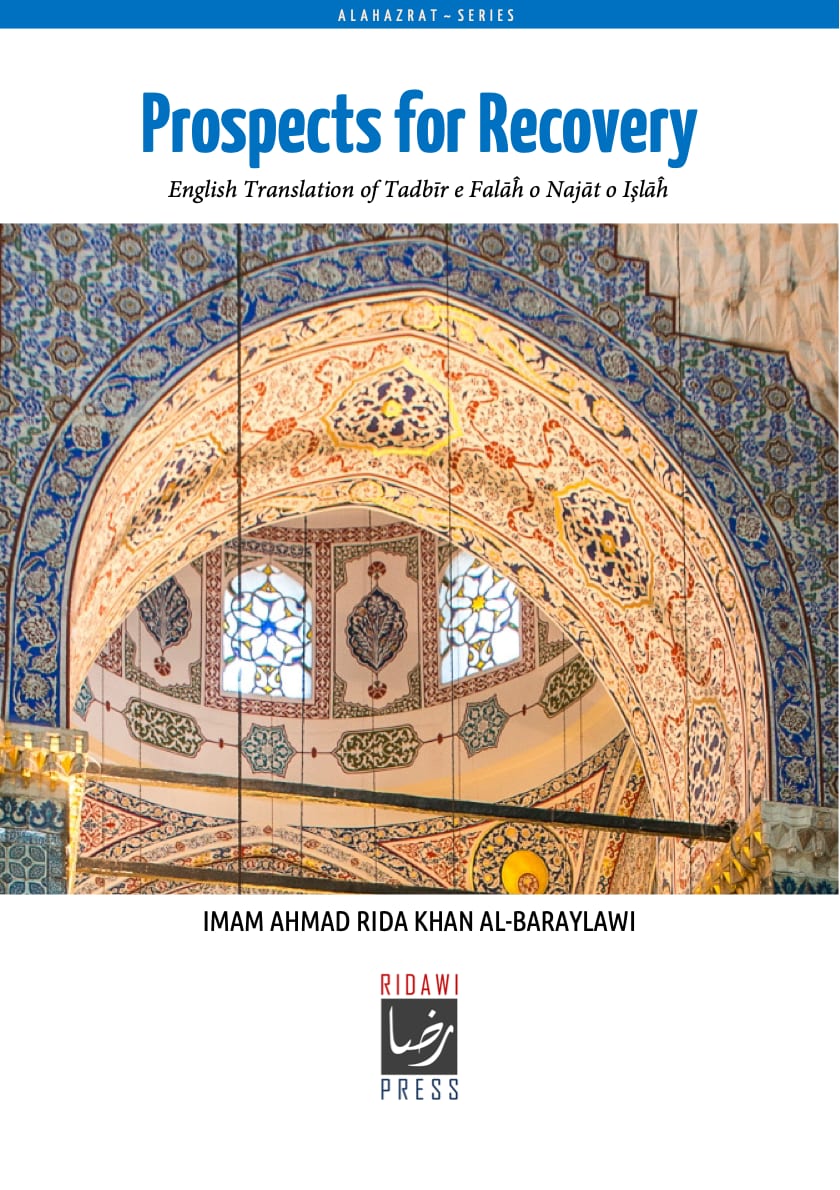
His answer, Tadbīr-e Falāĥ wa Najāt wa Işlāĥ, was printed in Bareilly that year.43 Ridawi Press has published it in English as Prospects for Recovery; the quotations below are from that translation.
He had read the newspapers “hoping for some good news”, but found “only sad news and more reports of suffering”, and he opened his answer with the verse, “Indeed, Allāh táālā will not change the state of a community so long as they do not change in themselves” (al-Ra‘d 13:11).44 Indian Muslims could not go to the battlefield, he wrote — but they could give, and they were not giving:
Where will Indian Muslims find the strength to leave their country, their wealth, their property and their families and go to a battlefield thousands of miles away and fight in wars alongside other Muslims? All they can do is donate money; and even in this undertaking, everyone can see their ‘contribution’. While Muslims are suffering in war-torn countries and elsewhere, people here are preoccupied with their own amusements … the same heedlessness and extravagance continue unabated.45
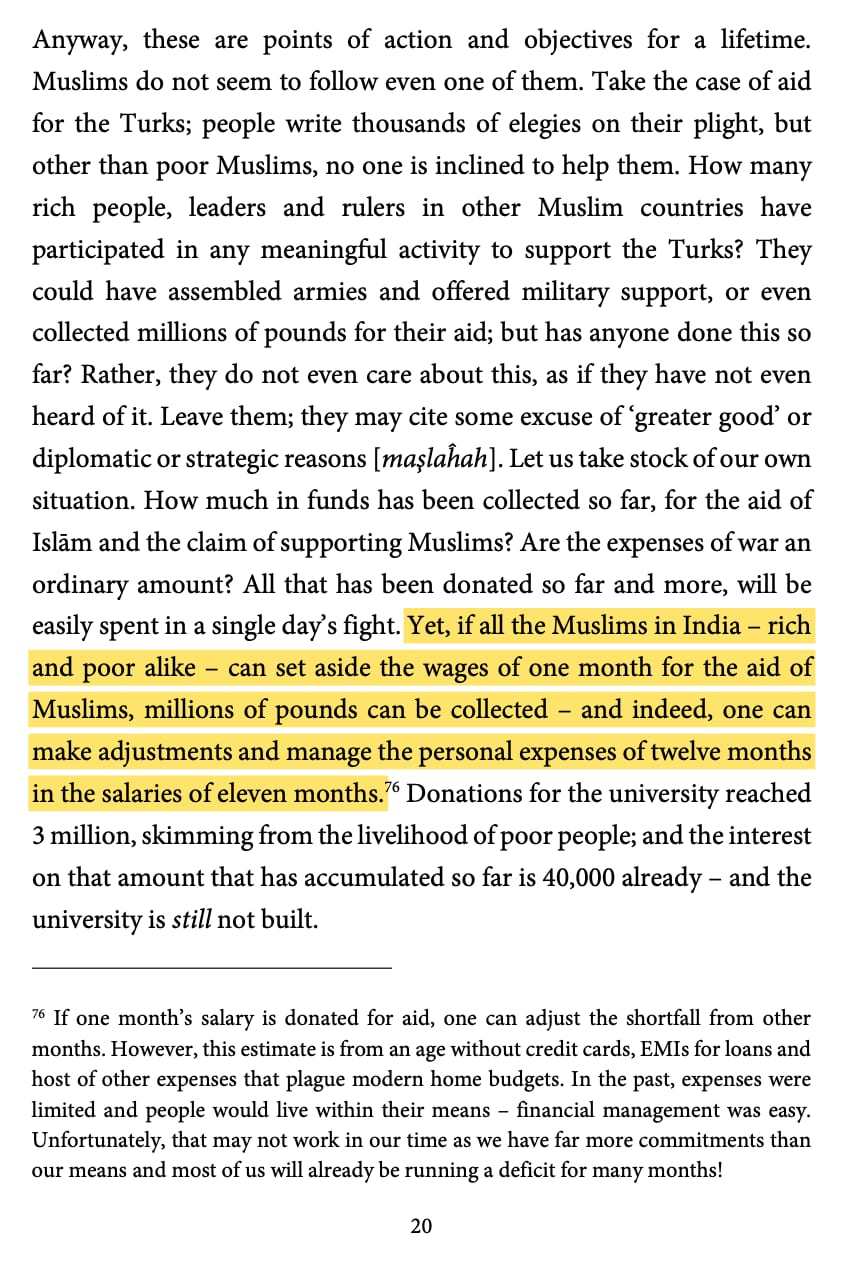
He named the remedy — one month’s wages:
Yet, if all the Muslims in India – rich and poor alike – can set aside the wages of one month for the aid of Muslims, millions of pounds can be collected – and indeed, one can make adjustments and manage the personal expenses of twelve months in the salaries of eleven months.46
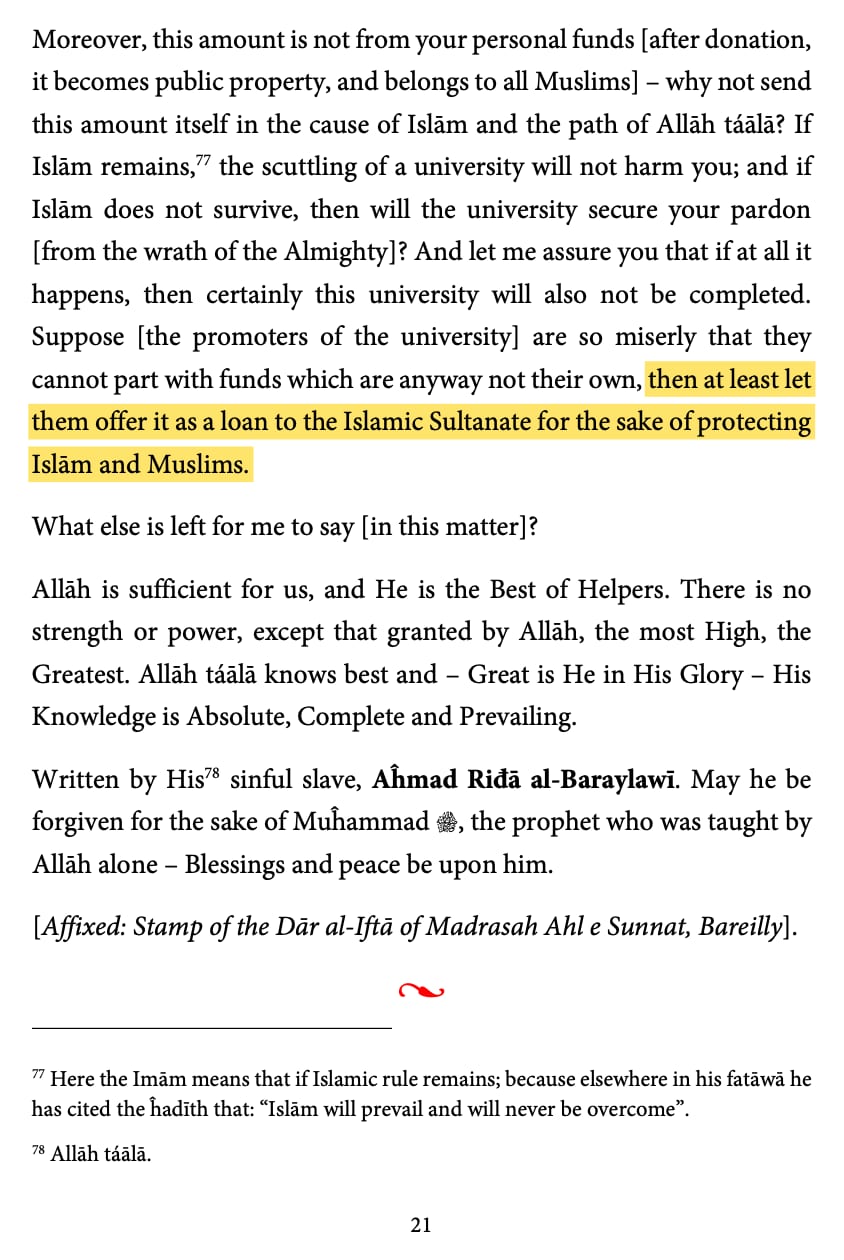
He rebuked the rulers of other Muslim countries, who had sent the Turks neither armies nor money, “as if they have not even heard of it”. Then he turned to the three million rupees collected for the proposed Muslim University, still unbuilt: why not send that money in the path of Allah? If its promoters could not part with it, “then at least let them offer it as a loan to the Islamic Sultanate for the sake of protecting Islām and Muslims.”47
For the longer term, he rejected a proposed boycott of European goods as impractical — it would not last, and in return Europe could “hurt [us] ten times more in a hundred different ways” — and set out instead a four-point programme for Muslims to stand on their own feet: settle their disputes among themselves rather than in the courts; trade within the community; let the wealthy Muslims of Bombay, Calcutta, Rangoon, Madras and Hyderabad found banks that profit by lawful means instead of interest; and, “the most important thing, the lifeblood of everything”, hold fast to the religion and its knowledge.48
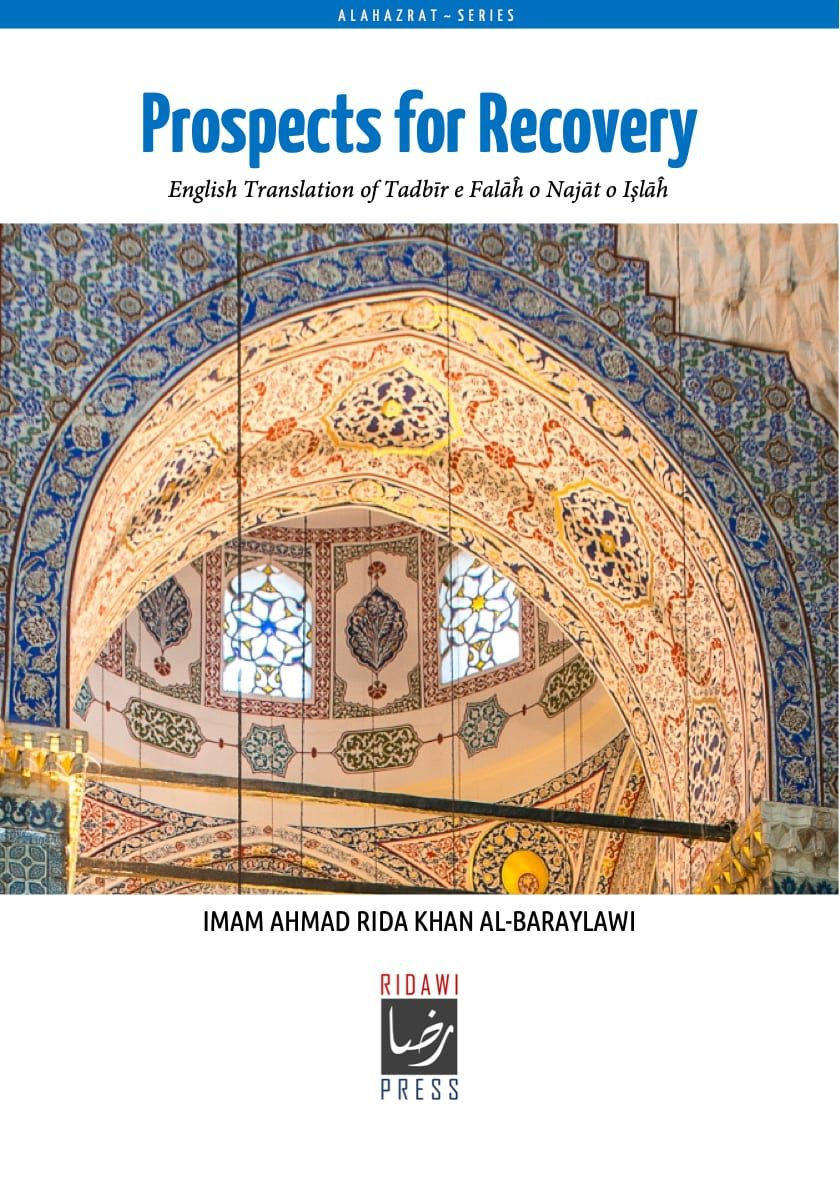
Prospects for Recovery, trans. Abu Hasan (Ridawi Press, 2018), cover. Source 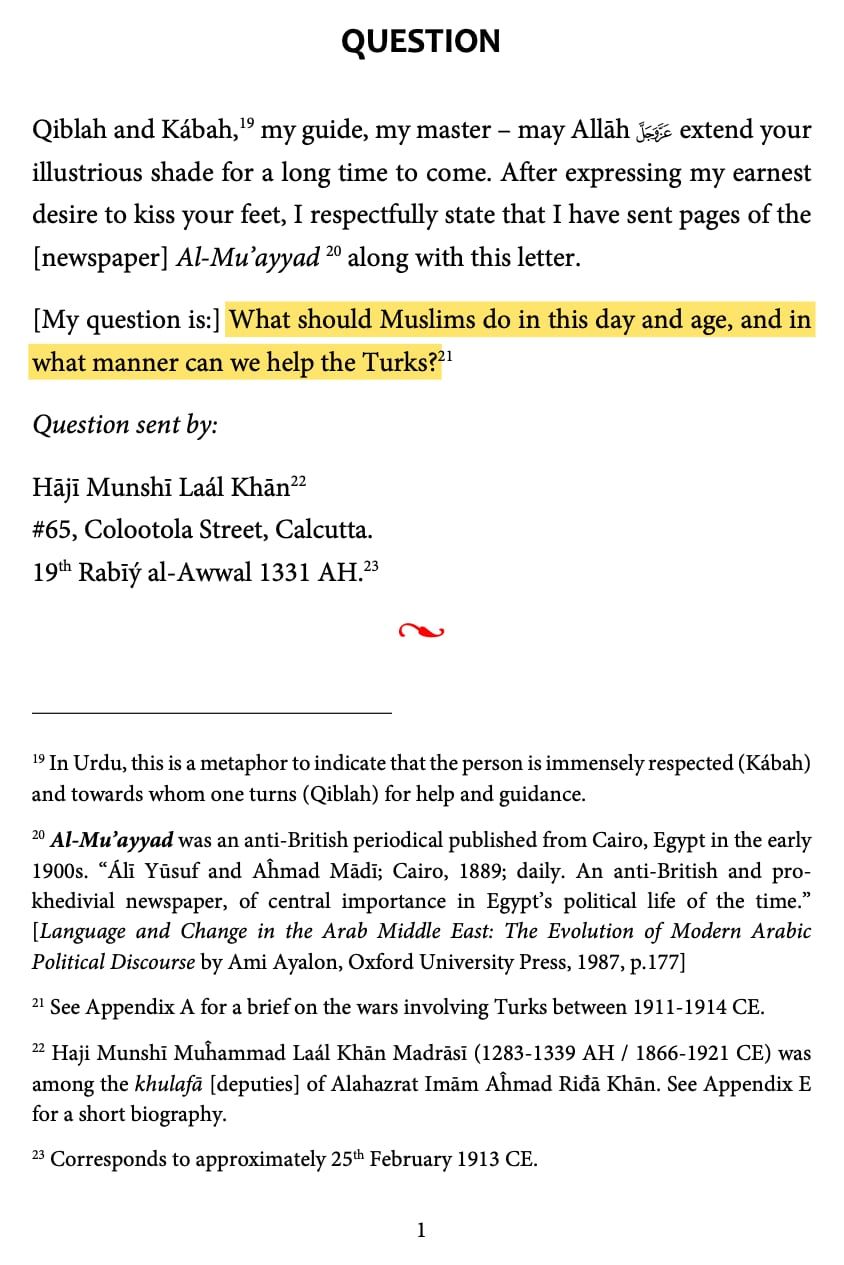
Prospects for Recovery, p. 1: the question (highlight ours). Source 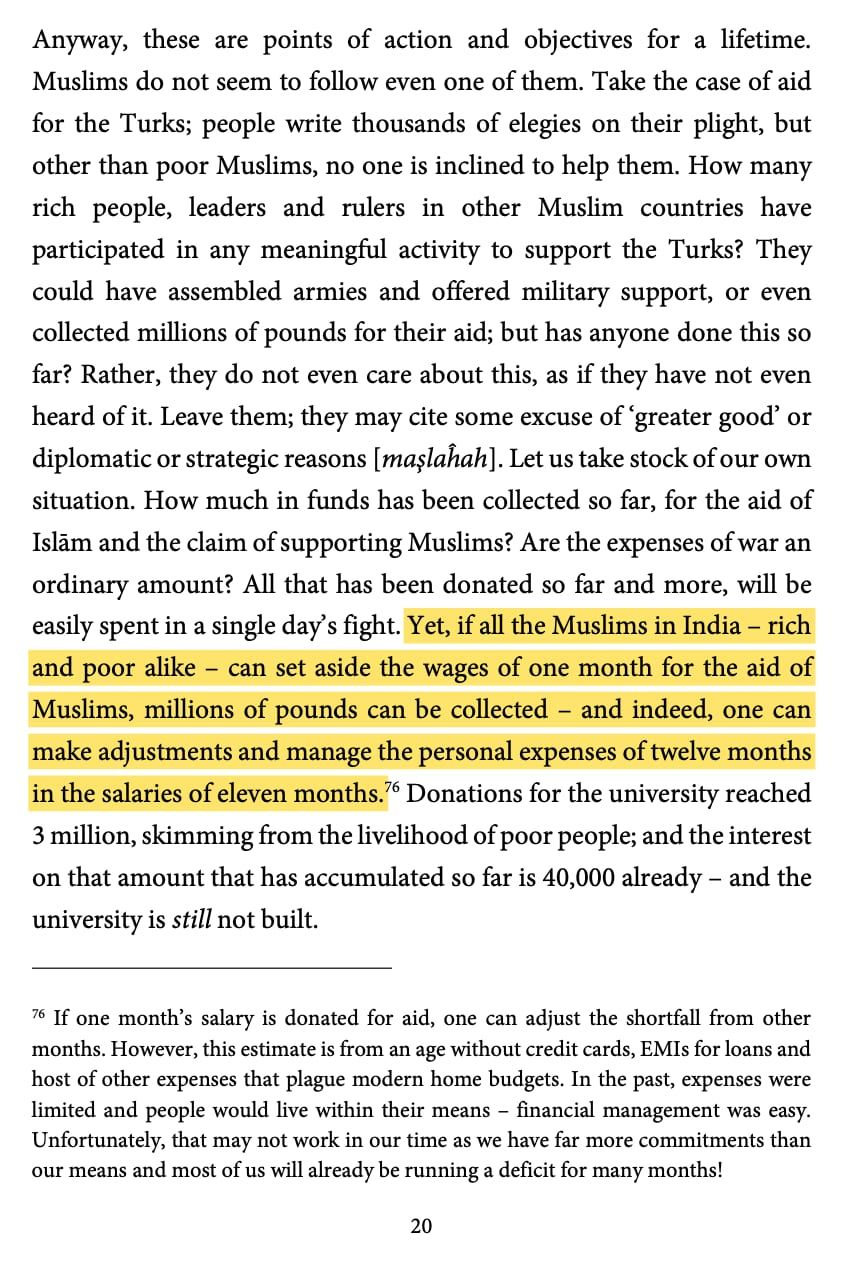
Prospects for Recovery, p. 20: one month’s wages (highlight ours). Source 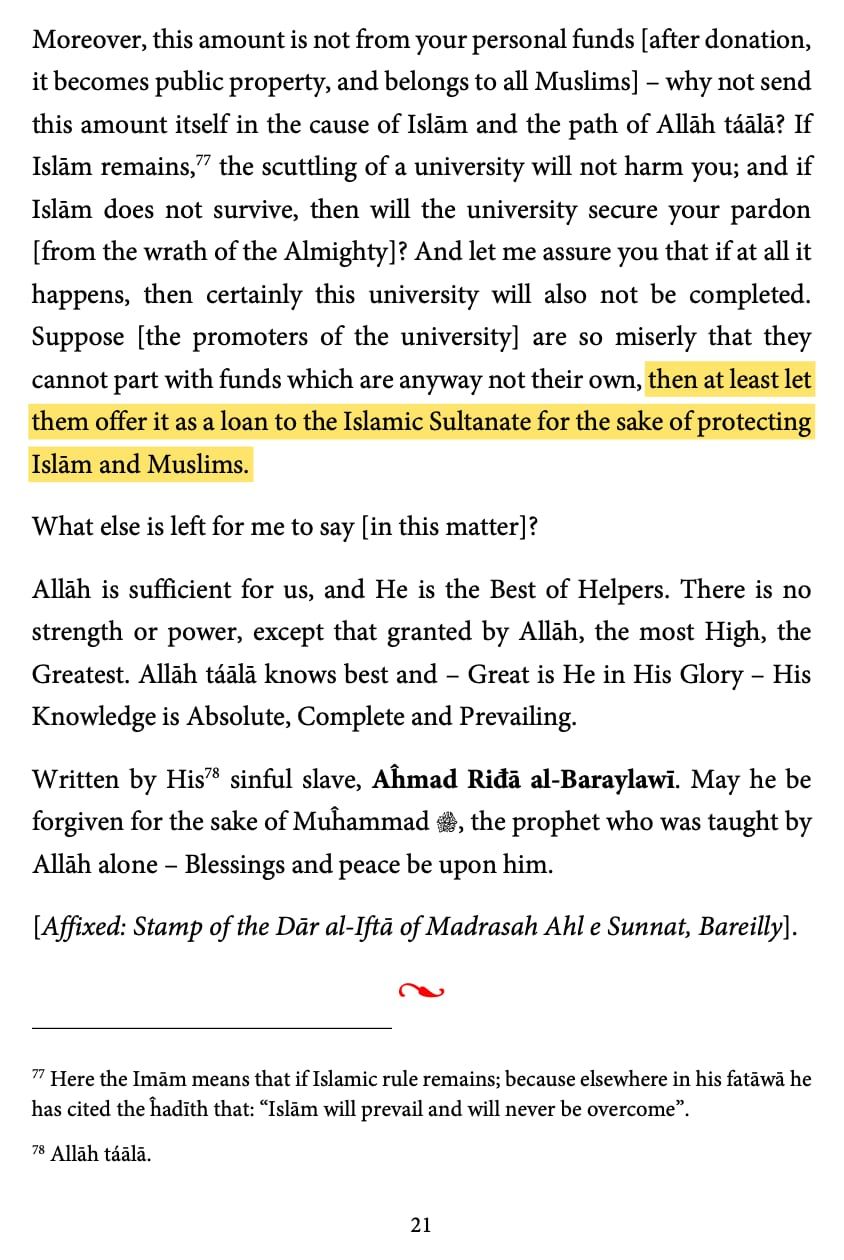
Prospects for Recovery, p. 21: a loan to the Islamic Sultanate (highlight ours). Source
His refusal to join the Anjuman-e Khuddam-e Ka‘ba — he objected to the wording of its constitution and to the presence in its leadership of scholars whose creed he could not accept — did not mean that he opposed helping the Ottomans.49
Anşār al-Islām, 1921
His closest students took this further. In Sha‘bān 1339 / 1921, shortly before his passing, Muhammad Miyan Marahrawi, Zafar ud-Din Bihari, Na‘im ud-Din Muradabadi, Didar ‘Ali Alwari and others founded the Anşār al-Islām, “one of the main purposes of which was to help the Turkish state and the holy places”, and adopted resolutions to that end, alongside the reforms of his 1913 fatwa.50
Türkiye and the Ottomans
His fatwa of 1920 on the caliphate
His fatwa Dawām al-‘Aysh fi’l-A’immah min Quraysh, written in 1339/1920, is a treatise on the conditions of the caliphate in Islamic law — not a judgement against the Turks. It sets out seven conditions for the shar‘ī caliph: that he be Muslim, free, male, sane, mature, able — and of Quraysh.51 “Among the Ahl-e Sunnat,” he wrote, “it is a condition of the shar‘i caliphate that the caliph be a Quraish,”52 citing hadith from al-Bukhārī and Muslim, such as “This matter will remain with Quraysh as long as two of them remain.”53 Other Muslim rulers, however powerful, were sultans — kings — and he showed from history that even the mightiest of them honoured a Qurashī caliph above themselves.54 This is the theory of the caliphate as the classical jurists set it out, above all al-Māwardī.55
His dispute was not with the Turks but with the leaders of the Khilafat movement in India, whom he criticised for using the issue of the caliphate as an “excuse for working toward their real goal of freedom [from the British]”, in alliance with Hindu politicians.56 He refused to tie support for the Turkish ruler to opposition to British rule in India: freedom from the British was one question, support for a shar‘ī institution another.57
The charge of being “pro-British”
In 1921 his opponents accused him of opposing help for the Ottoman sultan; he answered each charge in turn, and pointed out that those accusing him had themselves spent the money of ordinary Muslims on travel, meetings and festivities.58 Academic study of the evidence has concluded that his opposition to the Jam‘iyyat al-‘Ulama’-e Hind does not, in itself, prove that he was “pro-British”.59
Further reading
Biographies
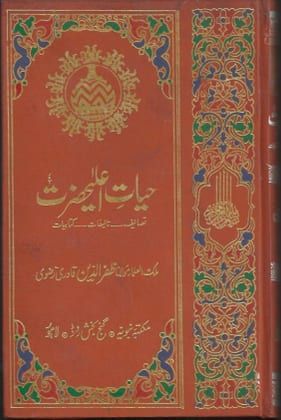
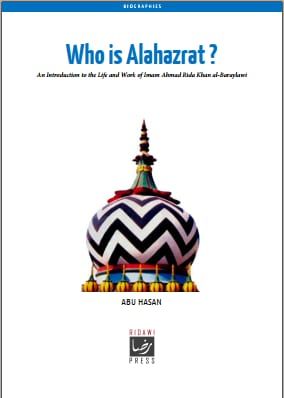
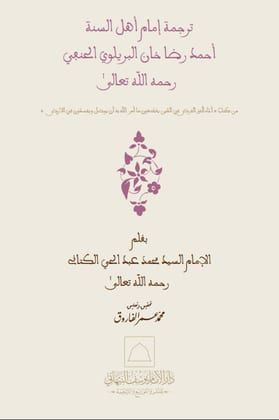
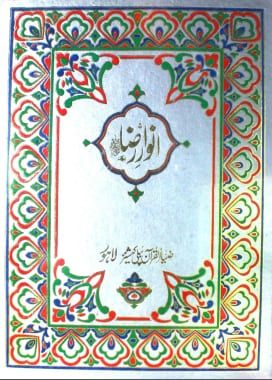
Given below is a list of well-known biographies of the Imam. Most of the works are in Urdu, but we have added an English and Arabic introduction. A longer list of books can be found in the download section.
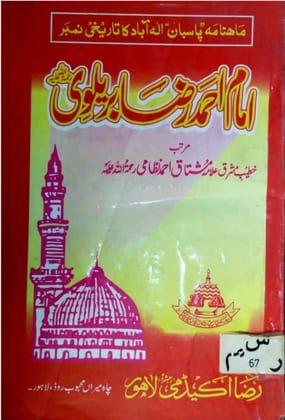
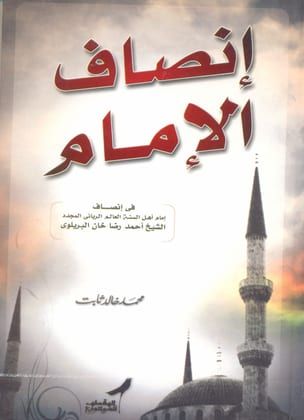
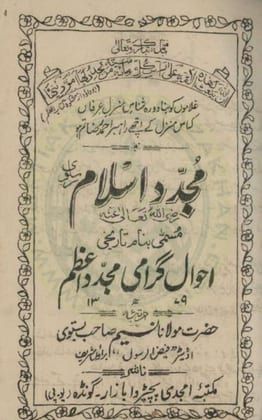
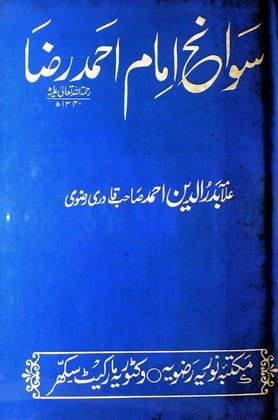
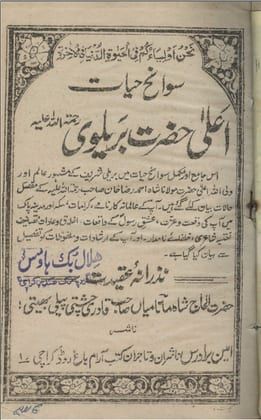
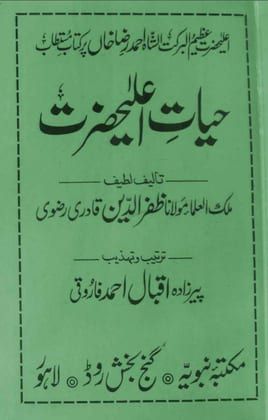
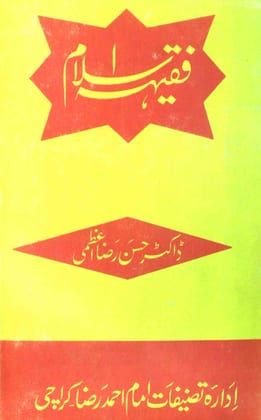
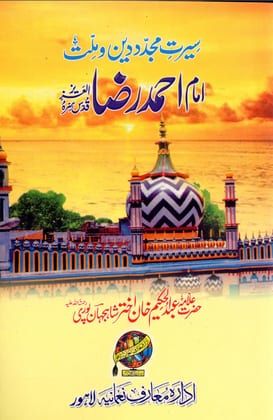


Sources
-
Abu Hasan, Who is Alahazrat? An Introduction to the Life and Work of Imam Ahmad Rida Khan al-Baraylawi, version 4.0 (Ridawi Press, 1440/2018), p. 24 — PDF. On the name Ábd al-Muşţafā, see the biography above. Back to reference 1
-
Şaĥīĥ al-Bukhārī, no. 15; Şaĥīĥ Muslim, no. 44. Translation as given in Who is Alahazrat?, p. 24. Back to reference 2
-
Alahazrat, Al-Ijāzāt al-Matīnah, as translated in Who is Alahazrat?, pp. 24–25. Back to reference 3
-
Alahazrat, Ab’hās e Akhīrah, as translated in Who is Alahazrat?, p. 25. Back to reference 4
-
Who is Alahazrat?, p. 66; on the year, p. 27. Back to reference 5
-
Muĥammad Khālid Thābit, preface to Inşāf al-Imām (Cairo: Dār al-Muqaţţam), as translated in Who is Alahazrat?, p. 26. Back to reference 6
-
Who is Alahazrat?, p. 64. Back to reference 7
-
Imam Ahmad Raza Khan, Hadaiq-e-Bakhshish, parts 1 and 2 (Mumbai: Raza Akademi, n.d.; editor’s note dated 20 December 1995), pp. 7, 27, 92, 114 and 244 — archive.org. Part 1 follows the first edition of 1325 AH, printed in his lifetime; part 2 follows the copy prepared by Mawlānā Ĥasanayn Riđā Khān (editor’s note, p. 4). Back to reference 8
-
Muhammad Afthab Cassim Qaadiri Razvi Noori, trans., Hadaa’iq e Bakhshish: The Gardens of Salvation, volumes 1 and 2 (Durban: Imam Mustafa Raza Research Centre, 2021), pp. 35, 66, 197, 242 and 405 — PDF. Back to reference 9
-
Who is Alahazrat?, p. 98. Back to reference 10
-
Who is Alahazrat?, p. 22. The couplets are Alahazrat’s, as transliterated and translated there. Back to reference 11
-
Abu Hasan, “Chain of Authorisation in Fiqh”, poster (Ridawi Press), with the Arabic text of the sanad from al-Fatāwā al-Riđawiyyah — ridawi.org. Names as on the poster. Back to reference 12
-
“The Za’irajah: A branch of the science of letter magic, (practiced) among the (authorities on letter magic), is (the technique of) finding out answers from questions by means of connections existing between the letters of the expressions (used in the question). They imagine that these (connections) can form the basis for knowing the future happenings they want to know.” [Ibn Khaldūn, Muqaddimah, Trans. Franz Rosenthal, 3/182.] In all these examples, it is kufr to believe that information obtained from such sciences (or pseudosciences) is absolutely true and certain (qaţýī–yaqīnī) and one who has obtained this information has absolute knowledge of unseen (is also kufr); but if one practices the Zayirjah or Jafar – as a guide similar to istikhārah and not with the belief or claim of absolute knowledge of unseen, it is not kufr. Allāh táālā knows best. Back to reference 13
-
The names of these 55 subjects in Arabic: 1) úlūm al-qur’ān; 2) úlūm al-ĥadīth; 3) uşūl al-ĥadīth; 4) fiqh al-ĥanafī; 5) fiqh al-madhāhib; 6) uşūl al-fiqh; 7) jadal; 8) tafsīr; 9) áqīdah – kalām; 10) naĥw; 11) şarf; 12) máānī; 13) bayān; 14) badīý; 15) manţiq; 16) munāżarah; 17) falsafah; 18) taksīr; 19) hay’ah; 20) ĥisāb; 21) handasah; 22) qirā’ah; 23) tajwīd; 24) taşawwuf; 25) sulūk; 26) akhlāq; 27) asmā’a ar-rijāl; 28) siyar; 29) tawārikh; 30) lughāh; 31) adab bi funūnih; 32) arithmaţīqī; 33) al-jabr wa’l muqābalah; 34) ĥisāb al-sittīnī; 35) loghārithmāt; 36) ílmu’t tawqīt; 37) al-manāzir wa’l marāyā; 38) ílmu’l ākar; 39) zījāt; 40) muthallath al-kurawī; 41) muthallath al-musaţţaĥ; 42) hay’ah al-jadīdah; 43) murabbáāt; 44) jafar; 45) zāyirjah; 46-47-48) inshā’a al-nażm fi’l árabiyyah, farisiyyah, hindiyyah; 49-50-51) inshā’a al-nathr fi’l árabiyyah, farisiyyah, hindiyyah; 52) khaţţ naskh; 53) khaţţ nastáliq; 54) tilāwah; 55) ílmu’l farāyiđ. Back to reference 14
-
Ĥāmid Riđā Khān (comp.), al-Ijāzāt al-Matīnah li-Úlamā’ Bakkah wa’l-Madīnah (Karachi: Maktabat al-Madīnah, n.d.), pp. 6–7 — archive.org. Back to reference 15
-
Muĥammad Ábd al-Ĥayy al-Kattānī, Fihris al-Fahāris wa’l-Athbāt, ed. Iĥsān Ábbās, 2nd ed. (Beirut: Dār al-Gharb al-Islāmī, 1402/1982), vol. 1, p. 86; he names him also at 1:59, 179, 369, 391, 427 and 2:675, 752, 875 — archive.org. Al-Kattānī always adds his father’s name, “Álī”. Back to reference 16
-
Al-Kattānī, Adā’ al-Ĥaqq al-Farđ, from the author’s manuscript, published as Tarjamat Imām Ahl al-Sunnah Aĥmad Riđā Khān, ed. Muĥammad Úmar al-Fārūq (Dār al-Imām Yūsuf al-Nabhānī, 1440/2018), pp. 10–11. Back to reference 17
-
Ĥusām al-Ĥaramayn álā Manĥar al-Kufr wa’l-Mayn, ed. Muĥammad Kāshif Maĥmūd al-Hāshimī (Karachi: Dār Ahl al-Sunnah, n.d.), contents pp. 222–224 — archive.org. Origins of the signatories as given in the editor’s notes. Back to reference 18
-
Ibid., p. 53. Bābşayl (d. 1330) was Muftī of the Shāfiýīs and shaykh of the scholars of Makkah. Back to reference 19
-
Al-Ijāzāt al-Matīnah, p. 11. Back to reference 20
-
Ĥusām al-Ĥaramayn (Dār Ahl al-Sunnah ed.), pp. 68–69, endorsement no. 7; the editor’s note there says he sought Alahazrat’s ijāzah in Makkah and was given it, and that he later taught at the Masjid al-Ĥarām and served as deputy judge of its Sharīáh court; he died in 1365. English from ridawi.org, “Praised by Scholars” (2 April 2022), which calls him Muftī of the Ĥanafīs and Qāđī of Makkah — ridawi.org. Back to reference 21
-
Muĥammad Munawwar Átīq (ed.), Taqārīż Úlamā’ al-Shām al-Qadīmah álā “al-Dawlah al-Makkiyyah” (n.d.), pp. 63–65 (facsimile and transcription) — archive.org. The endorsement was also printed at the end of the Lahore edition of al-Dawlah al-Makkiyyah. Back to reference 22
-
Ibid., pp. 62–147; Tāj al-Dīn al-Ĥasanī’s endorsement is on p. 114. Back to reference 23
-
Ibid., p. 108, signed in Madinah, Rabīý al-Awwal 1333. Back to reference 24
-
Ibid., pp. 100–105; the words quoted are on p. 102. Signed on p. 105, “written in his own hand: Mūsā Álī, Shāmī by origin, al-Azharī al-Aĥmadī al-Dardīrī al-Madanī”, dated 1 Rabīý al-Awwal 1330. Translation ours. Back to reference 25
-
Mushtāq Aĥmad Shāh, al-Imām Aĥmad Riđā wa Atharuhu fi’l-Fiqh al-Ĥanafī, MA (takhaşşuş) thesis, Faculty of Sharīáh and Law, al-Azhar University, supervised by Prof. Ábd al-Fattāĥ Muĥammad al-Najjār (1997); printed in Karachi. Back to reference 26
-
Ĥāzim Muĥammad Aĥmad Maĥfūż (ed.), al-Kitāb al-Tidhkārī: Mawlānā al-Imām Aĥmad Riđā Khān (Cairo: Dār al-Ittiĥād al-Taáāwunī, Şafar 1420 / June 1999). Back to reference 27
-
Muĥammad Khālid Thābit, Inşāf al-Imām (Cairo: Dār al-Muqaţţam, n.d.), p. 5. Back to reference 28
-
Publisher’s list in Ĥusām al-Ĥaramayn (Dār Ahl al-Sunnah ed.), pp. 226–231: editions by Dār al-Hijrah al-Ūlā and Dār al-Şāliĥ, Cairo (2017–19), and Dār al-Faqīh, Abu Dhabi (2015). Back to reference 29
-
Fâideli Bilgiler (Istanbul: Hakikat Kitabevi, 121st printing, 2026), p. 406; Islam’s Reformers (Hakikat Kitabevi, 2021), p. 237 n. — hakikatkitabevi.net. Back to reference 30
-
Fatāwā al-Ĥaramayn bi Rajf Nadwat al-Mayn, wa yalīhi al-Durrat al-Muđiyyah (Istanbul: Hakikat Kitabevi, 1440 AH / 2019), title page — PDF. Back to reference 31
-
Ithbāt al-Nubuwwah, wa yalīhi al-Dawlat al-Makkiyyah bi’l Māddat al-Ghaybiyyah (Istanbul: Hakikat Kitabevi, 1436 AH / 2015), p. 36 — PDF. Back to reference 32
-
Al-Mútaqad al-Muntaqad, with al-Mustanad al-Mútamad (Istanbul: Hakikat Kitabevi, 1440 AH / 2019), title page — PDF. Back to reference 33
-
Hüseyin Hilmi Işık, Tam İlmihâl Se’âdet-i Ebediyye (Istanbul: Hakikat Kitabevi, 156th printing, 2026), p. 455 — PDF. Back to reference 34
-
Hüseyin Hilmi Işık, Fâideli Bilgiler (Istanbul: Hakikat Kitabevi, 121st printing, 2026), p. 140 — PDF. Back to reference 35
-
Fâideli Bilgiler, p. 420. Back to reference 36
-
Abdulhamit Birışık, “Rızâ Han Birelvî”, TDV İslâm Ansiklopedisi, vol. 35 (Istanbul, 2008), pp. 61–64 — islamansiklopedisi.org.tr. Back to reference 37
-
Muhammad Khalid Masud, “Fetâvâ-yı Rızviyye”, TDV İslâm Ansiklopedisi, vol. 12 (Istanbul, 1995), pp. 445–446 — islamansiklopedisi.org.tr. Back to reference 38
-
Recep Durgun, “Ahmet Rıza Han Barelvi’nin Hadâik-i Bahşiş Adlı Eserinde Hz. Peygamber ile İlgili Benzetmeler”, Selçuk Üniversitesi Sosyal Bilimler Enstitüsü Dergisi 37 (2017), pp. 122–133 — PDF. Back to reference 39
-
Cübbeli Ahmet Hoca, condolence statement, 22 July 2018, on his official website — cubbeliahmethoca.com.tr. Back to reference 40
-
Abdulhamit Birışık, “Rızâ Han Birelvî”, TDV İslâm Ansiklopedisi, vol. 35 (Istanbul, 2008), pp. 61–64 — islamansiklopedisi.org.tr. Back to reference 41
-
Ahmad Rida Khan, Prospects for Recovery: English Translation of Tadbīr e Falāĥ o Najāt o Işlāĥ, trans. Abu Hasan (Ridawi Press, Muĥarram 1440 / September 2018), p. 1; the conversion to 25 February 1913 is the translator’s — PDF. Sanyal, p. 281, also dates the question to February 1913. Back to reference 42
-
Ahmad Riza Khan, Tadbīr-e Falāĥ wa Najāt wa Işlāĥ (Bareilly: Hasani Press, 1331/1913), 15 pp.; Usha Sanyal, Devotional Islam and Politics in British India: Ahmad Riza Khan Barelwi and His Movement, 1870–1920 (Delhi: Oxford University Press, 1996), p. 281 and n. 45. Sanyal notes that both the question and the fatwa refer to “the Turks” rather than “the Ottomans”. Page numbers in the notes that follow are to the Ridawi Press translation. Back to reference 43
-
Prospects for Recovery, pp. 2–3; Sanyal, pp. 281–282, citing the Urdu original, p. 3. Back to reference 44
-
Prospects for Recovery, p. 7. Sanyal, p. 282, translates the same passage from the Urdu original (pp. 5–6): “the same meetings, the same colour, the same theatre … the same useless expense … When it comes to helping the poor of Islam, the enthusiasm expressed is sky high; [but] the actions which accompany it are at floor level.” Back to reference 45
-
Prospects for Recovery, p. 20; Sanyal, p. 282, citing the Urdu original, p. 14. Sanyal renders the sum as “tens of thousands of pounds”. Back to reference 46
-
Prospects for Recovery, pp. 20–21. The translator notes (p. 7 n. 45) that the three million rupees was the Muslim University Fund. Back to reference 47
-
Prospects for Recovery, pp. 8–11; Sanyal, p. 283, citing the Urdu original, pp. 6–8. The translator’s preface (pp. vii–ix) notes that the call for Muslim banks makes Alahazrat among the earliest advocates of Islamic banking in modern times. Back to reference 48
-
Sanyal, p. 281. Back to reference 49
-
Sanyal, pp. 284–285, citing al-Sawād al-A‘żam (Muradabad) 2:5 (Sha‘bān 1339/1921), pp. 2–8. Back to reference 50
-
Ahmad Riza Khan, Dawām al-‘Aysh (written 1339/1920; Lahore: Maktaba Rizwiyya, 1980), pp. 46, 50, as summarised in Sanyal, p. 288 n. 69. Back to reference 51
-
Dawām al-‘Aysh, p. 46, as translated in Sanyal, p. 288. Back to reference 52
-
Sahih al-Bukhari, no. 3501; Sahih Muslim, no. 1820. Sanyal, pp. 288–289, notes that the fatwa cites hadith from al-Bukhārī and Muslim on the Qurashi condition (Dawām al-‘Aysh, pp. 65–68). Back to reference 53
-
Sanyal, pp. 288–290, citing Dawām al-‘Aysh, pp. 47–56 and p. 51 (the Mamluk sultan Baybars installing an ‘Abbasid caliph). Back to reference 54
-
Sanyal, pp. 287–288. Back to reference 55
-
Dawām al-‘Aysh, p. 95, as quoted in Sanyal, p. 287; on the alliance with Hindus, Sanyal, pp. 290–291, citing al-Mahajjat al-Mu’tamanah (1339/1920). Back to reference 56
-
Sanyal, p. 287. Back to reference 57
-
Sanyal, p. 278, and p. 282 n. 49, citing Dabdaba-e Sikandari (Rampur), January 1921, incl. 57:20 (31 January 1921), p. 4. Back to reference 58
-
Sanyal, p. 297. Back to reference 59
Abbreviations and references
- Source
- “Imam Ahmad Rida Khan”, ridawi.org. Text and images reproduced with the permission of the site’s owner; a few outdated details have been corrected. — ridawi.org
- Opening quotation
- Abu Hasan, Who is Alahazrat? An Introduction to the Life and Work of Imam Ahmad Rida Khan al-Baraylawi, version 4.0 (Ridawi Press, 1440/2018), p. 1. — ridawipress.org
Reproduced from ridawi.org with the permission of its owner. Death dates and outdated details have been corrected, and a sentence that referred to an excerpt not present on the source page has been removed. The sections “Love of the Prophet ﷺ”, “Alahazrat in the Arab world”, “Recognised in Türkiye” and “Alahazrat and the Ottoman Turks” are by Jamiaturraza Istanbul. Photographs of the shrine are from Wikimedia Commons (CC BY-SA, credited beneath them).
Last updated 1 November 2026